

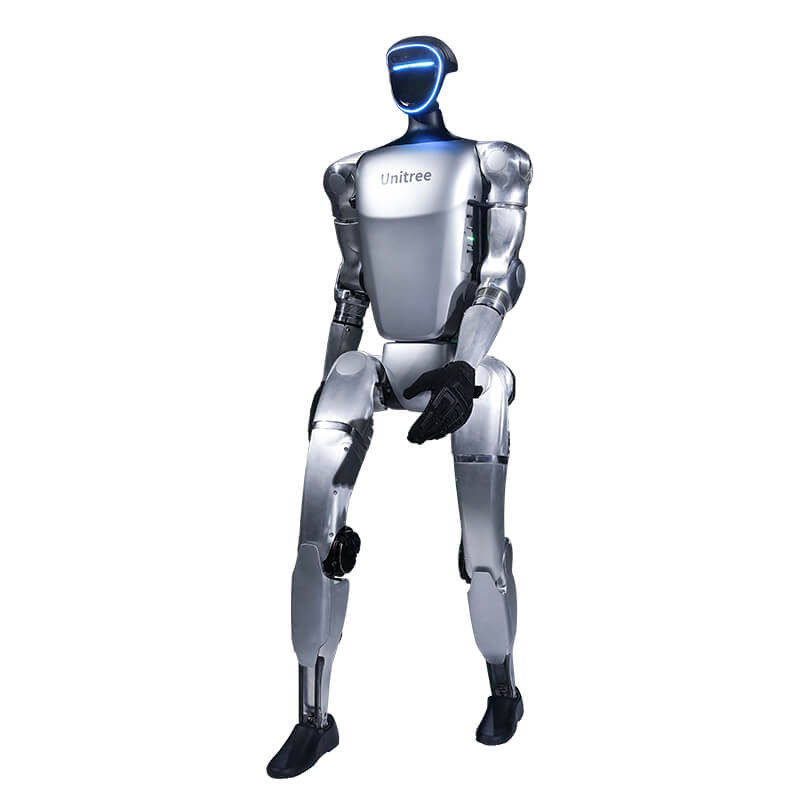
Updated August 2026. Prices last verified August 2026.
Unitree now sells more than a dozen distinct robot platforms across quadruped, humanoid, and dual-arm lines, and the differences between them are not obvious from spec sheets. This guide walks through every current product line, gives you four gating questions that settle most purchase decisions, and includes a full cross-model comparison matrix with verified US pricing.
Everything here reflects current 2026 US pricing. Pricing is subject to change, so contact us for a formal quote before budgeting. For line-by-line configuration pricing, see our Unitree robot price guide. All robots at Global Drone HQ are sourced through Unitree's authorized U.S. distribution with U.S.-based authorized warranty and repair service. The full lineup lives in our Unitree collection.
The Unitree Lineup in One Table
| Robot | Line | Type | 2026 US Price | Primary Buyer |
|---|---|---|---|---|
 |
Go2 | Quadruped | From $3,790 | Enthusiasts, educators, developers |
 |
Go2-W | Wheeled quadruped | $13,000 to $32,299 | Inspection teams |
 |
As2 | Quadruped | $9,500 to $19,900 | Labs needing more than a Go2 |
 |
A2 | Advanced quadruped | $31,900 to $46,900 | Heavier payload field work |
 |
B2 / B2-W | Industrial quadruped | Quoted per deployment | Industrial, public safety, fire service |
 |
R1 | Compact humanoid | $6,870 to $32,900 | Entry humanoid research, education |
 |
G1 | Humanoid | $21,600 to $73,900 | Research labs, AI developers |
 |
H2 | Full-size humanoid | $40,900 to $68,900 | Human-scale robotics research |
Before you compare individual models, work through the four questions below. They settle most Unitree purchase decisions faster than any spec sheet.
Gate 1: Do You Need to Program It?
This is the single most expensive question in the catalog, so answer it first. The base G1, base H2, and base R1 do not support secondary development. There is no SDK, and there is no upgrade path from a base unit to an Edu unit later. If you buy a base humanoid and then discover your team needs to write code for it, you are not buying an upgrade kit. You are buying a second robot.
The rule: any research, custom development, or student programming requires an Edu tier. Base models are operated through Unitree's standard app and preloaded behaviors only. This one fork can roughly triple the price of a humanoid, which is exactly why it needs to be decided before anything else.
On the quadruped side the same logic applies: the Go2 Pro and Go2 X are consumer units with no developer access, while the Go2 Edu unlocks the SDK.
Gate 2: How Much Onboard Compute?
Base units ship with an 8-core CPU that handles locomotion and the standard app. Edu tiers add NVIDIA Jetson Orin compute at 100 TOPS, which is what you need for onboard perception, navigation stacks, and learned policies running on the robot rather than a tethered workstation. At the top of the range, the H2 Edu supports top-tier AI compute options for running large model workloads directly onboard. If your research plan involves onboard inference, budget for the compute tier now rather than retrofitting later.
Gate 3: Which Hands?
Hands are one of the largest line items in humanoid configuration pricing, and they are easy to overlook. The options run from simple grippers, to three-finger hands, to five-finger dexterous hands, with tactile-sensing versions available on higher tiers. If your work is locomotion, balance, or whole-body control, basic end effectors are fine and save real money. If your work is manipulation research, the dexterous and tactile options are the point of the purchase, and they explain much of the price spread between otherwise similar configurations.
Gate 4: Walking Robot or Data-Acquisition Platform?
Not every embodied-AI program needs legs. If your goal is teleoperation and imitation-learning data collection, a dedicated data platform is often more productive per dollar than a bipedal humanoid. The G1-D data-acquisition series ($38,800 to $66,300) is built for exactly this, and the R1-A5 ($4,290 to $23,890) and R1-A7 ($4,890 to $24,490) dual-arm platforms put manipulation hardware on a desk mount or mobile base at a fraction of humanoid pricing. Many labs collect better demonstration data with a dual-arm rig than with a full humanoid that spends half its time being balanced.
Every Unitree Model Compared
This is the full matrix: every current model we carry, verified pricing, whether it supports secondary development, and who it is actually for.
| Model | Price (2026 US) | SDK access | Best for |
|---|---|---|---|
| Humanoids | |||
| R1 Air | $6,870 | No | Lowest-cost humanoid for demos and STEM exposure |
| R1 Basic | $8,990 | No | Entry humanoid with better sensing, app-driven use |
| R1 Edu Standard | $15,950 | Yes | Student programming and coursework |
| R1 Edu Smart | $18,900 | Yes | Teaching labs that need more sensing |
| R1 Edu Pro | $19,800 to $32,900 | Yes | Humanoid research on a smaller budget |
| G1 | From $21,600 | No | Events and demonstrations |
| G1 Pro | $27,990 | No | Higher-spec demos without development |
| G1 Edu Standard | $43,900 | Yes | The default research humanoid |
| G1 Edu Plus | $53,900 | Yes | Research with more compute and hand options |
| G1 Edu Pro | $45,900 to $56,900 | Yes | Manipulation-focused research configs |
| G1 Edu Ultimate | $55,900 to $73,900 | Yes | Flagship research configurations |
| G1-Comp | $48,900 | No | Athletic competition and showcase events |
| G1 Edu Combat | $63,900 | Yes | Combat-sport demos with developer access |
| G1-D | $38,800 to $66,300 | Yes | Imitation-learning data collection |
| H2 | $40,900 | No | Full-size demonstrations and display |
| H2 Edu | $68,900 | Yes | Human-scale research with top AI compute options |
| Quadrupeds | |||
| Go2 Pro | $3,790 | No | Enthusiasts, classrooms, content creation |
| Go2 X | $7,600 | No | Prosumer use without programming |
| Go2 Edu | From $11,190 | Yes | University locomotion and navigation research |
| Go2 Ent | From $13,205 | Yes | Commercial patrol and specialized sensing |
| Go2-W | From $13,000 | Yes | Wheeled inspection on industrial floors |
| Go2-W Inspection | $32,299 | Yes | Turnkey facility inspection rounds |
| AS2 | $9,500 to $19,900 | Edu config only | Labs needing more than a Go2 |
| A2 | $31,900 to $46,900 | Yes | Heavy-payload outdoor field missions |
| B2 | Quoted per deployment | Yes | Industrial and public-safety programs |
| Dual-arm data platforms | |||
| R1-A5 | $4,290 to $23,890 | Yes | Desk-mount dual-arm data collection |
| R1-A7 | $4,890 to $24,490 | Yes | Dual-arm teleoperation and mobile-base work |
Prices last verified August 2026 against Global Drone HQ product listings. SDK availability reflects Unitree's published configuration sheets: secondary development is supported on Edu tiers and development platforms, not on base consumer units. Request a quote to confirm current pricing and configuration before budgeting.

Quadrupeds: Go2 Through B2
Go2: The Default Starting Point
The Go2 is where most people should start. At approx. 15 kg with speeds up to approx. 3.5 m/s, the Unitree 4D LiDAR L2 (360°×96°), and 12 joint motors, it delivers genuinely impressive legged mobility at a price that no longer requires a grant application. The Go2 Pro at $3,790 suits enthusiasts, content creators, and classroom demos. The Go2 X at $7,600 adds capability for prosumers who plan to push the platform harder. For a deeper breakdown of every Go2 variant, see our Go2 series guide.
The moment you want to write your own code, you need the Go2 Edu, from $11,190. Edu unlocks the SDK and developer access that the consumer models lock out, which is why it is the standard pick for university robotics programs.
For commercial work, the Go2 Ent line starts at $13,205, with gas-detection and thermal-plus-PTZ configurations for inspection missions.
Go2-W: When Wheels Beat Feet
The Go2-W puts powered wheels on the Go2 platform, from $13,000. On flat industrial floors wheels are faster and more efficient, and the legs still handle steps and rough ground. An NVIDIA Jetson Orin NX 16GB (100 TOPS) compute dock is standard, with secondary development supported. The turnkey Go2-W Inspection Package at $32,299 bundles the sensors and software for routine facility inspection rounds.

As2 and A2: The Middle Tier
The As2 series, $9,500 to $19,900, is the step up when a Go2 is not quite enough but an industrial platform is overkill. Official As2 tiers are Air, Pro, and Edu; at approx. 20 kg it delivers roughly twice the power performance of the Go2, with an IP54 rating on the Pro and Edu (none on the Air). The A2 series, $31,900 to $46,900, moves into serious field territory: bigger payloads, longer missions, and more robust construction for outdoor deployment. The A2 carries an IP56 rating, operates from -20°C to 55°C, runs over 5 hours and approx. 20 km unloaded on dual hot-swap 9,000 mAh batteries, supports a 100 kg standing load, handles steps up to 30 cm, and reaches 3.7 m/s.
B2: The Industrial Workhorse
The B2, the wheeled B2-W, and the Fire and Rescue configuration are quoted per deployment rather than sold at list price. The B2 is certified IP67 and can operate submerged, carries up to 120 kg standing (40 kg walking), runs 4 to 6 hours or over 20 km per charge, and operates from -20°C to 55°C (per Unitree user manual). These are the platforms for utility inspection, hazardous-environment work, and public safety programs, and pricing depends entirely on payloads, autonomy requirements, and site conditions. If you are scoping a B2 program, start with a quote request and a conversation about the mission.

Humanoids: R1, G1, and H2
R1: The Accessible Humanoid
The R1 Air at $6,870 (approx. 27 kg, 20 degrees of freedom, monocular camera) is the least expensive credible humanoid on the market, and the R1 Basic at $8,990 (approx. 29 kg, 26 degrees of freedom, binocular depth camera) adds capability for light use. For institutions, the R1 Edu line runs from the Edu Standard at $15,950 through the R1 Edu Smart at $18,900 to Edu Pro configurations between $19,800 and $32,900. Unitree's official tiers are R1 Air, R1 (Base), and R1 EDU; the Edu Smart and Edu Pro configurations are dealer builds on the R1 EDU tier. Budget around approx. 1 hour of runtime per charge (per Unitree user manual). The R1 is the right call for high schools, community colleges, and labs that want hands-on humanoid work without a six-figure line item. Remember Gate 1: the R1 Air and R1 Basic do not support secondary development, so programming coursework needs an Edu unit.
G1: The Research Standard
The G1 is the humanoid you see in research papers and viral videos alike: approx. 1.32 m tall, approx. 35 kg, 23 degrees of freedom on the base model (G1 Edu configurations expand from 23 to 43 with optional Dex3-1 dexterous hands plus optional wrist and waist modules), and a quick-release battery good for approx. 2 hours. A 3D LiDAR (LIVOX MID360) and Intel RealSense D435i depth camera come standard on every configuration. The base G1 is $21,600 and the G1 Pro is $27,990. Research configurations start with the G1 Edu Standard at $43,900 and climb through Edu Pro, Edu Plus, and Edu Ultimate tiers to $73,900, with teleoperation bundles quoted on request. There are more than 16 configurations in total, differing mainly in SDK access, onboard NVIDIA Jetson compute, dexterous hands, and teleop hardware. Our G1 configurations guide walks through every tier in detail.
H2: Full-Size Ambitions
The H2 is Unitree's full-size humanoid for labs working at true human scale. It stands 1.82 m tall, weighs approx. 70 kg, offers 31 degrees of freedom, and runs approx. 3 hours per charge, with Intel Core i5 compute standard (i7 on the Edu) and an optional NVIDIA Jetson AGX Thor (2,070 TOPS). The standard H2 is $40,900 and the H2 Edu is $68,900. Choose the H2 when your research specifically requires human-scale reach, stride, and workspace interaction that the smaller G1 cannot replicate.
What Can These Robots Actually Do Today?
Marketing videos set expectations that hardware does not always meet, so here is the honest state of the art. Walking, balance recovery, and preloaded motion routines are genuinely reliable on current Unitree platforms. Stair climbing works in demos but remains unreliable in unstructured environments and carries real fall risk. Manipulation is still rudimentary: picking up arbitrary objects reliably is an open research problem, not a shipped feature. The viral acrobatics you have seen are trained policies that are staged or teleoperated; they are impressive control engineering, not autonomous decision-making.
Two practical consequences follow. First, these platforms carry no collaborative-safety certification such as ISO 13482, so treat them as lab and demonstration equipment, not as machines that share space with the public unattended. Second, for humanoid development work we recommend a protective gantry ($850), which pays for itself the first time a policy fails mid-experiment. We would rather set expectations correctly than field a warranty claim on a robot that was asked to do something no robot can do yet.
Who Is Actually Using Unitree Robots?
These platforms are past the novelty stage. The police department in Pullman, Washington operates a Go2 for special operations support. Research groups at DFKI and TU Darmstadt have used Unitree platforms in published locomotion research. A Unitree platform has also been deployed for inspection work at a major international airport. The pattern across these deployments is consistent: quadrupeds doing patrol, inspection, and research work today, with humanoids concentrated in labs.
Which Robot Should You Buy?
By Budget
| Budget | Recommendation |
|---|---|
| Under $5,000 | Go2 Pro. Nothing else comes close at this price. |
| $5,000 to $12,000 | Go2 X or Go2 Edu for quadruped work; R1 Air or R1 Basic if you want a humanoid. |
| $12,000 to $25,000 | Go2 Edu or Ent configs, As2, R1 Edu, or the base G1 at $21,600. |
| $25,000 to $50,000 | G1 Pro, G1 Edu Standard, A2 series, Go2-W Inspection Package, or the H2. |
| $50,000+ | G1 Edu Plus, Ultimate, or Combat; H2 Edu; or a quoted B2 deployment. |
By Use Case
| Use case | Best fit |
|---|---|
| Research labs | Go2 Edu, G1 Edu |
| Embodied-AI data collection | G1-D, R1-A5, R1-A7 |
| Security patrol | Go2 Ent, AS2, A2 |
| Industrial inspection | A2, B2, Go2-W Inspection Package |
| Education | R1 Edu, Go2 Edu |
| Events and demonstrations | Base G1, R1, G1-Comp |
- Research labs and universities: Edu tiers, full stop. Go2 Edu for locomotion and navigation work, R1 Edu on smaller budgets, G1 Edu for manipulation and embodied AI, H2 Edu at human scale. The SDK and developer access in Edu tiers are what make publishable work possible.
- Public safety: Go2 Ent variants for affordable capability, A2 for heavier field missions, B2 and B2 Fire and Rescue for demanding deployments. One important note for government buyers: Unitree is a Chinese manufacturer, and agencies subject to federal procurement rules should verify their procurement policies before committing budget. We are direct about this because surprises at the purchasing stage help nobody.
- Industrial inspection: Go2-W Inspection Package for routine indoor rounds, Go2 Ent configurations for specialized sensing, A2 or a quoted B2 program for large facilities.
- Events, content, and consumers: Go2 Pro or Go2 X, the R1 Air if a humanoid draws the crowd you want, or the base G1 and G1-Comp for headline demos. Base non-programmable models are ideal here: they are built to run demos without a robotics engineer on staff.
US availability note: current Unitree models with FCC equipment authorizations granted before July 28, 2026 remain available for purchase in the United States. If you are verifying a specific model's status before a procurement, our Unitree FCC covered list guide for US buyers walks through how to check.
How Buying Works
Quotes
Every product page has a quote request option. Tell us the model, configuration, and timeline, and we respond with a formal written quote, typically the same business day. Quotes are the source of truth on pricing: list prices in this guide are current 2026 US MSRP and subject to change.
University and Institutional Purchase Orders
We work with university purchasing departments regularly and can provide formal quotes on letterhead, W-9 documentation, and vendor registration information for your procurement system. If your institution requires a PO process, request a quote first and mention it: we will structure the paperwork so it moves through purchasing without friction.
Warranty and US-Based Support
Robots purchased through Global Drone HQ are sourced through Unitree's authorized U.S. distribution and include U.S.-based authorized warranty and repair service. That distinction matters more than most buyers realize. A direct import means that when the robot breaks, it ships back to the manufacturer in China for service, with the transit time, customs paperwork, and months of downtime that implies. Gray-market units also frequently arrive with firmware and documentation limitations that complicate development work. Buying through authorized channels keeps service, parts, and support stateside.
Frequently Asked Questions
What is the best Unitree robot for beginners?
The Go2 Pro at $3,790. It is affordable, durable, and capable enough to stay interesting long after the first week.
Which Unitree robot is best for research?
An Edu tier, always: base models have no SDK. Go2 Edu for locomotion and navigation research, G1 Edu for manipulation and embodied AI, R1 Edu on smaller budgets, and H2 Edu when the work requires human scale.
What are the key differences between the R1, G1, and H2?
Size, capability, and price. The R1 is a compact, affordable humanoid ($6,870 to $32,900) suited to education and entry research. The G1 ($21,600 to $73,900) is the research standard, with the widest range of compute, hand, and configuration options. The H2 ($40,900 to $68,900) is full human scale at 1.82 m, for work that needs human-sized reach and stride.
Can the base G1 be upgraded to Edu later?
No. There is no upgrade path from a base G1 to a G1 Edu, and the same is true for the base R1 and base H2. If you may ever need SDK access, buy the Edu tier up front.
Do I need an Edu model?
Only if you plan to program the robot. Edu tiers unlock SDK and developer access. If you just want to operate the robot with its standard app and behaviors, consumer tiers are fine and much cheaper.
How does Unitree compare to Boston Dynamics on price?
Published Spot deployments commonly run well into six figures once sensors, software, and support are included. Unitree platforms cover comparable inspection and patrol roles starting from a fraction of that, which is a major reason labs and agencies evaluate them side by side.
Are Unitree robots legal to buy in the US?
Yes. Current models with FCC equipment authorizations granted before July 28, 2026 remain available for purchase. Our FCC covered list guide explains how to verify a specific model.
Are Unitree robots NDAA compliant?
No. Unitree is a Chinese manufacturer and its robots are not NDAA compliant. Buyers subject to NDAA or similar federal procurement restrictions should factor that in before budgeting; we are happy to discuss alternative platforms if compliance rules a Unitree purchase out.
Can government agencies buy Unitree robots?
Many state and local agencies do. Unitree is a Chinese manufacturer, so any agency subject to federal procurement restrictions should verify its procurement policies before purchasing. If compliance requirements rule out Unitree, we also carry platforms from other manufacturers and can discuss alternatives.
How long does delivery take?
It varies by model and configuration, and popular configs move fast. Ask about current lead times when you request a quote and we will give you an honest number.
Is financing available?
Ask when requesting a quote. Options depend on the buyer type and order size, and institutional purchases often have their own payment structures.
Ready to Choose?
Browse the full Unitree collection, open the product page for the model that fits your budget and mission, and request a quote. If you are still torn between two models, say so in the quote request and we will give you a straight recommendation based on what you are actually trying to do.
Still deciding between configurations?
Tell us your use case and budget and we will walk you through the right configuration, then send a formal quote. University, agency, and multi-unit pricing available.
Request a Quote
Share:
Unitree G1 Configurations Decoded: Basic vs Pro vs Edu (All 16+ Configs Explained)
Pressure Washing Drones (2026): What They Can Wash, What They Cost, and Where to Buy in the USA