

Updated August 2026.
The Unitree G1 is one robot with more than 16 price tags, running from $21,600 for the base robot to $73,900 for a maxed-out Edu Ultimate. Base, Pro, Comp, Edu Standard, Edu Plus, Edu Pro, Edu Ultimate, Boxing, and a mobile-base G1-D series on top. Unitree's own materials do not make the differences easy to parse, and buyers routinely either overspend on capability they will never use or, worse, buy a tier that cannot do the one thing they bought it for.
This guide decodes the entire G1 lineup. Every G1 we sell is sourced through Unitree's authorized US distribution. See the full lineup in our Unitree collection and Unitree humanoids collection, or start wider with our Unitree robot buyers guide and Unitree price guide.
The single most expensive mistake G1 buyers make is ordering a base G1 for research. The base G1 and G1 Pro do not support secondary development. There is no SDK access, and there is no upgrade path from a base unit to an Edu unit. If your team needs to write code, train policies, or run ROS 2, you need a G1 Edu configuration from day one. Buying wrong means buying twice.
Which G1 can you actually program?
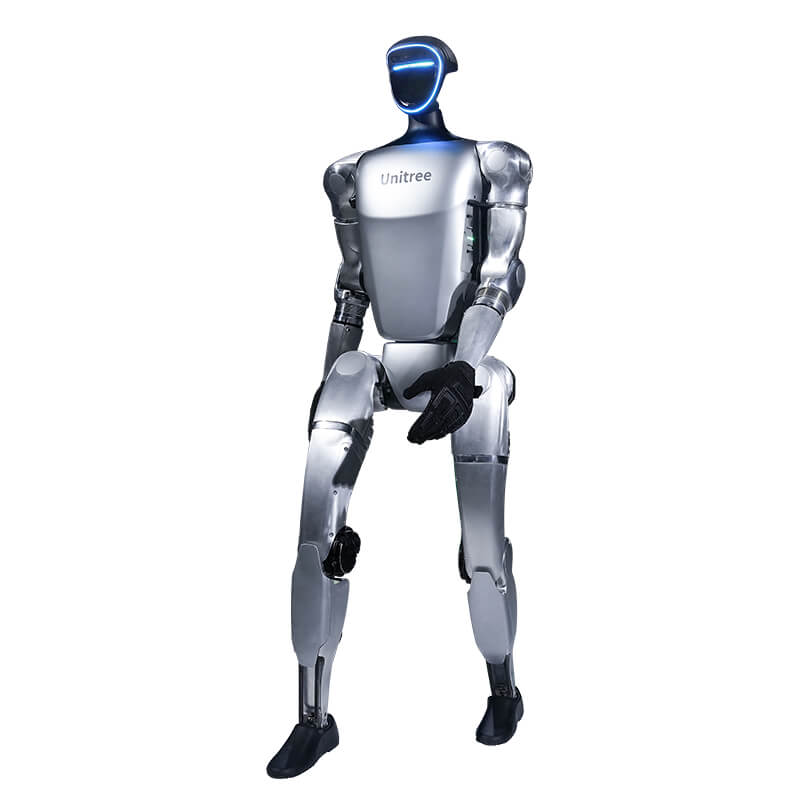
Every G1 configuration shares the same core robot: approx. 1.32 m tall, approx. 35 kg, and 23 degrees of freedom on the base model, with a quick-release battery good for approx. 2 hours of operation. Edu configurations expand well beyond that, reaching up to 43 degrees of freedom with dexterous hands plus optional wrist and waist modules. What changes between tiers is not the skeleton. It is compute, hands, software access, and sensing.
The dividing line in the whole range is Edu. The base G1 is a complete, walking, balancing humanoid at the lowest price in the lineup, and the G1 Pro upgrades its capability, but neither supports secondary development. You get the robot and its standard behaviors, not the low-level access researchers need. Buy base or Pro for demonstrations, exhibits, content, and evaluation. The Edu tiers unlock NVIDIA Jetson-class compute rated at 100 TOPS for secondary development and a full SDK with Python, C++, and ROS 2 support, which is why nearly every university lab, corporate research team, and serious AI developer lands there despite the price jump.
Every G1 configuration and price
One naming note first: some resellers label the Edu tiers U1, U2, and so on. Those are shorthand used by some resellers, not official Unitree names. We use Unitree's own configuration names throughout.
| Model | SDK / secondary development | DoF or key difference | Price |
|---|---|---|---|
| G1 (base) | No | 23 DoF, entry humanoid | From $21,600 |
| G1 Pro | No | Upgraded base robot, still not a dev platform | $27,990 |
| G1-D Data Acquisition series | Data-collection platform | Upper body on lifting-column mobile base | $38,800 to $66,300 |
| G1 Edu Standard | Full SDK | Entry point to real development | $43,900 |
| G1 Edu Pro | Full SDK | Up to 37 DoF, hand and sensing options | $45,900 to $56,900 |
| G1-Comp Athletic | Competition build, confirm at quote | Competition-tuned hardware | $48,900 |
| G1 Edu Plus | Full SDK | 29 DoF, 100 TOPS compute | $53,900 |
| G1 Edu Ultimate | Full SDK | Up to 43 DoF, top hand options | $55,900 to $73,900 |
| G1 Edu Combat (Boxing) | Full SDK | Contact-sport demonstration build | $63,900 |
Prices last verified August 2026. All prices are US MSRP and subject to change, so request a formal quote before budgeting. Unitree also offers teleoperation bundles for imitation-learning data collection; those are quote-only, so ask us for current pricing.
What does each Edu tier add?
- Edu Standard, $43,900: The entry point for real development work. Full SDK access with Python, C++, and ROS 2 support in a development-ready configuration.
- Edu Plus, $53,900: 29 degrees of freedom with 100 TOPS of secondary development compute for running perception and learned policies onboard.
- Edu Pro, $45,900 to $56,900: Configurations reach 37 degrees of freedom; the spread in price comes mostly from hand and sensing choices.
- Edu Ultimate, $55,900 to $73,900: The maximum research spec, with configurations reaching up to 43 degrees of freedom for manipulation research.
Two specialty builds sit alongside the Edu line. The G1-Comp Athletic at $48,900 is tuned for robot competition events, and the Edu Combat (Boxing) configuration at $63,900 is built for the contact-sport demonstrations Unitree has made famous. These are niche builds aimed at event organizers and entertainment buyers.
What do the hand options change?
Edu Pro and Edu Ultimate configurations differ primarily by hand choice, and hands are a large share of the price delta between configurations. Options across the lineup include simple grippers, three-finger dexterous hands with tactile variants, and five-finger dexterous hands from multiple vendors. The practical rule: choose tactile options when your manipulation research needs contact data, and do not pay for five-finger dexterity if your use case is pick-and-place.
For reference, GDHQ carries Unitree Dex1-1 gripper accessories at $380, $580, and $1,080 depending on variant, plus common add-ons like the MID360 LiDAR at $3,800, a depth camera at $1,200, a gantry at $850, and a spare battery at $750. Exact per-hand pricing inside a full G1 configuration depends on the build, so request a quote with your required hand configuration for a firm number. Prices last verified August 2026.
What is the G1-D and when is it the better buy?
The G1-D series puts the G1's upper body on a lifting column over a mobile base, purpose-built for data acquisition. It is not a walking biped: the Standard version uses a caster base with approx. 2 hours of runtime, while the Flagship rides a powered chassis good for approx. 6 hours at up to 1.5 m/s (per Unitree user manual). Sacrificing legs buys you stability, endurance, and simpler operation, which is exactly what you want when the goal is collecting thousands of clean manipulation episodes rather than studying locomotion. Configurations run $38,800 to $66,300 depending on compute, sensing, and hand options. If your roadmap is imitation learning and dataset collection rather than bipedal control, the G1-D is often the better buy than a legged Edu unit.
Which configuration should you order?
| You are | Buy this | Why |
|---|---|---|
| An enthusiast or content creator | G1 base or G1 Pro | Full humanoid presence, no dev premium |
| An events or entertainment company | G1 Pro, or Comp/Boxing for staged events | Reliability and spectacle over SDK access |
| A university teaching program | Edu Standard | Full SDK at the lowest Edu price |
| A research lab in locomotion or control | Edu Plus or Edu Pro | Onboard compute for real experiments |
| A manipulation or embodied-AI lab | Edu Ultimate with dexterous hands | Up to 43 DoF and tactile hand options |
| An AI company building training datasets | G1-D series or a teleop bundle (quote only) | Purpose-built for demonstration data |
Two rules of thumb cover most mistakes. First: if anyone on your team will write code for the robot, the minimum viable purchase is Edu Standard at $43,900. No amount of cleverness turns a base G1 into a dev platform. Second: buy the sensors and hands you need in the original configuration. Retrofitting capability after purchase is somewhere between painful and impossible, and it is never cheaper.
Wondering about US radio certification? See our Unitree FCC coverage guide for US buyers for the current status of each model.
If the G1's price range gives you pause, the R1 line offers a much lower-cost entry into humanoid development, starting with the R1 Air and R1 Edu Smart. Compare the whole range in our Unitree price guide.
The same logic applies to the H2
If you are considering Unitree's full-size humanoid instead, the fork is identical. The base H2 at $40,900 does not support secondary development, and research teams need the H2 Edu at $68,900 with its compute and hand upgrade paths. Same rule, bigger robot: if your team will write code, order the Edu configuration from day one. Prices last verified August 2026.
Not sure which G1 configuration fits your program?
Tell us what your team needs to build and we will spec the right configuration, hands, and compute, then send a formal quote. University and lab pricing available.
Request a QuoteFrequently asked questions
Can the base Unitree G1 be programmed?
No. The base G1 and G1 Pro do not support secondary development, so there is no SDK access for writing your own code, training policies, or running ROS 2. Development access starts at the Edu tier.
Can I upgrade a G1 to Edu later?
No. There is no upgrade path from a base G1 or G1 Pro to an Edu configuration. Capabilities are baked into the configuration at purchase, so order an Edu unit from the start if your team will ever write code for the robot.
How much does the G1 Edu cost?
G1 Edu configurations run from $43,900 for Edu Standard to $73,900 for a top Edu Ultimate build. Edu Plus is $53,900, Edu Pro runs $45,900 to $56,900, and the Edu Combat (Boxing) build is $63,900. Prices last verified August 2026.
What is the difference between Edu Standard, Plus, Pro, and Ultimate?
All four include the full SDK. Edu Standard is the entry development configuration; Edu Plus adds 29 degrees of freedom and 100 TOPS of compute; Edu Pro configurations reach 37 degrees of freedom; Edu Ultimate reaches up to 43 degrees of freedom with the top hand options for manipulation research.
What is the G1-D?
A data-acquisition variant that mounts the G1 upper body on a lifting column over a mobile base instead of legs. It runs $38,800 to $66,300 and is built for AI teams collecting manipulation data at scale, not for locomotion research.
Is the G1 Pro a development platform?
No. The G1 Pro at $27,990 is an upgraded robot with the same standard behaviors as the base G1. If SDK access matters, skip Pro and go straight to Edu Standard at $43,900.
How much does a Unitree G1 with hands cost?
Dexterous hands appear mainly in Edu Pro ($45,900 to $56,900) and Edu Ultimate ($55,900 to $73,900) configurations, and hand choice drives most of the price spread. Request a quote with your required hand configuration for an exact number.
Does the Unitree H2 have the same Edu split?
Yes. The base H2 at $40,900 does not support secondary development. Research teams need the H2 Edu at $68,900, which adds the compute and hand upgrade paths needed for development work.
Share:
Unitree Robot Price Guide 2026: Every Model and What It Costs
Unitree Robot Buyer's Guide 2026: Which Robot Is Right for You?