

Updated September 2026: this guide has been fully refreshed. Two platforms previously listed here have been discontinued by DJI. The Matrice 350 RTK is replaced by the Matrice 400, and the Mavic 3 Thermal is replaced by the Matrice 4T. Neither is available new.
Buying with federal grant money?
The drones below will not clear NDAA procurement. We quote the ones that will.
If your program runs on COPS, DHS, FEMA, or other federal funding, DJI and Autel are off the table. Global Drone HQ sources Blue UAS-cleared platforms for law enforcement, including the Parrot ANAFI USA GOV, Freefly Astro, and Inspired Flight systems, and we handle the compliance paperwork that comes with them.
Get an NDAA-Compliant Quote See the 2026 approved listWhy Police Departments Are Adding Drones in 2026
More than 1,500 US law enforcement agencies now fly drones, and the reasons are practical: a thermal drone finds a fleeing suspect or a missing person in minutes, an overhead camera documents a crime scene before evidence is disturbed, and a Drone as First Responder (DFR) program puts eyes on a 911 call before the first patrol unit arrives. For the full mission-by-mission breakdown, see our Matrice 4 for police and law enforcement guide.
Quick Picks: Best Police Drones for 2026
- Best overall for patrol and tactical work: DJI Matrice 4T ($7,849)
- Best flagship for multi-payload missions: DJI Matrice 400 ($10,450)
- Proven all-weather workhorse: DJI Matrice 30T ($12,602)
- Best no-geofencing option: Autel EVO Max 4T XE ($8,999)
- Best for DFR / autonomous response: DJI Dock 3 + Matrice 4TD (from $15,890)
- Discontinued: DJI Mavic 3T, replaced by the Matrice 4T
DJI Matrice 4T: Best Overall Police Drone

Price: $7,849 complete kit (battery, RC Plus 2 controller, charging hub, and case included)
The Matrice 4T is the drone most departments should buy first, and it is the direct replacement for the discontinued Mavic 3T. It pairs a 640x512 radiometric thermal sensor with a long-range zoom camera and an 1,800 m laser rangefinder, and packs into a case that lives in a patrol vehicle or command truck. AI subject detection helps operators track people and vehicles during searches and pursuits, and the whole kit deploys in about a minute.
It anchors our entire Matrice 4 Series guide, and the dedicated law enforcement playbook covers recommended configurations, accessories, and DFR paths in depth. Upgrading from a Mavic 3T? See our Matrice 4T vs Mavic 3T comparison.
Best for: patrol support, tactical overwatch, SAR, and any department building its first serious drone program.
DJI Matrice 400: Best Flagship (Replaces the Matrice 350 RTK)

Price: $10,450 (aircraft; payloads sold separately)
If you searched for the Matrice 350 RTK and could not find it, this is why: DJI has discontinued the M350, and the Matrice 400 is its successor in every respect. It flies longer (up to 59 minutes), carries more (6 kg across multiple simultaneous payloads), transmits farther (20 km O4 Enterprise), and adds LiDAR plus millimeter-wave radar sensing for obstacle avoidance in low light where camera-only systems struggle.
For law enforcement, the M400's dual-payload capability is the headline: pair a Zenmuse H30T thermal-zoom camera with a spotlight or loudspeaker and one aircraft covers surveillance, search, and crowd communication in a single flight. RTK positioning delivers centimeter-level accuracy for crash and crime scene reconstruction, replacing hours of ground survey work with a 20-minute flight.
Read the full DJI Matrice 400 review and buyer's guide for specs, payload pairings, and configuration advice.
Best for: agencies flying multiple mission types with one airframe, accident reconstruction teams, and departments upgrading from an M300 or M350 with Zenmuse payloads already on the shelf.
DJI Matrice 30T: The Proven All-Weather Workhorse

Price: $12,602
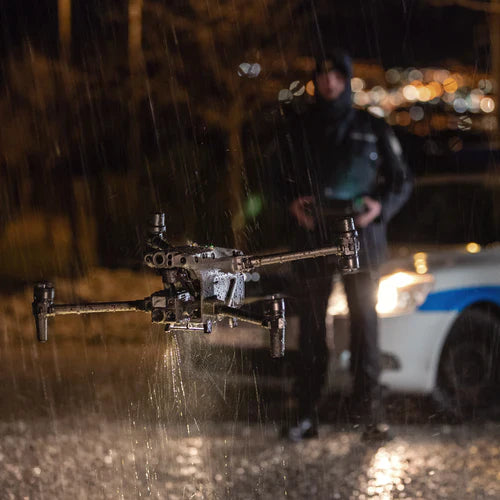
The Matrice 30T remains one of the most widely deployed police drones in the country for a simple reason: it flies in weather that grounds smaller aircraft. IP55 sealing, an operating range of -20°C to 50°C, and Level 7 wind tolerance mean the M30T launches during the storm response, not after it. The integrated payload combines 640x512 radiometric thermal, 200x hybrid zoom, and a 1,200 m laser rangefinder.
Best for: regions with hard weather, storm and disaster response, and agencies that want a field-proven platform with years of documented public safety service.
DJI Mavic 3T: Discontinued
The Mavic 3T packed the same 640x512 thermal resolution as the bigger aircraft into a 920 g foldable airframe with a 45-minute flight time and a 56x hybrid zoom. It was the drone that rode in the trunk of every patrol supervisor's vehicle. DJI has discontinued it and it can no longer be sourced.
Departments that were planning to buy one should specify the Matrice 4T ($7,849), which fills the same compact, rapid-deployment role and adds an 1,800 m laser rangefinder the Mavic 3T never had. For law enforcement that difference is significant: a rangefinder turns a thermal contact into GPS coordinates you can pass to units on the ground. Background and full specs remain in our Mavic 3T guide.
Autel EVO Max 4T XE: Best No-Geofencing Option
Price: $8,999
The EVO Max 4T XE's defining feature for law enforcement is launch authority: Autel does not enforce software geofencing, so when your team has airspace authorization for an emergency near an airport or critical infrastructure, the drone launches on your command rather than waiting on a manufacturer unlock. The payload combines 640x512 thermal, 10x optical zoom, a 1.2 km laser rangefinder, A-Mesh networking, and SLAM navigation for GPS-denied environments, with Level 12 wind resistance.
Note on procurement: Autel is subject to the same federal NDAA restrictions as DJI (see the compliance section below). The EVO Max's advantages are operational, not regulatory. For long-endurance VTOL missions, its bigger sibling the Autel Alpha ($19,289) adds a 35x optical zoom and extended range.
Best for: agencies operating near controlled airspace and teams that prioritize launch authority and mesh networking.
DJI Dock 3 + Matrice 4TD: Best for Drone as First Responder
Price: from $15,890 (dock; aircraft sold with bundle options)
DFR is the fastest-growing model in police aviation: a docked drone launches automatically on a 911 call and streams live video to responding officers before they arrive, cutting response times and giving commanders a live read on whether a subject is armed or fleeing. The Dock 3 with the Matrice 4TD runs 24/7 with no pilot on site, in an IP56-rated station that can be vehicle-mounted for mobile operations. Our complete DJI Dock 3 review covers bundles, BVLOS rules, and deployment examples.
Best for: agencies building DFR programs, campus and facility perimeter coverage, and departments that need response without staffing a pilot around the clock.
NDAA Compliance: What Federally Funded Agencies Need to Know
Many police drone programs are funded with federal grants (COPS, DHS, FEMA) that require NDAA-compliant equipment. Be aware that neither DJI nor Autel is NDAA compliant: both are Chinese manufacturers, both were added to the FCC Covered List in late 2025, and neither appears on the DIU Blue UAS Cleared List. Departments purchasing with unrestricted state or local funds can and widely do deploy the platforms in this guide. If your funding requires NDAA compliance, consider Blue UAS-cleared platforms such as the Skydio X10 or Parrot ANAFI USA, and see our NDAA-compliant drones guide for the full approved list.
Accessories and Battery Logistics
The drone is half the program. Budget for:
- Spotlights, loudspeakers, and beacons for night search, crowd communication, and visibility compliance
- Spare batteries sized to your shift length, not your flight time; a full patrol shift typically needs a 4 to 8 battery rotation
- Rapid field charging so that rotation stays topped off from a vehicle inverter; our battery management guide for public safety and DJI field charging guide cover the proven setups
- Payload and sensor upgrades from our cameras and sensors collection as missions expand
Agencies rounding out the program are also adding ground robots for interior reconnaissance work, pairing a quadruped that clears structures with the aerial platforms above.
How to Choose (and Buy) the Right Police Drone
Work through four questions:
- Mission profile: patrol support and SAR point to the M4T; multi-payload and reconstruction work points to the M400; continuous response points to the Dock 3.
- Weather reality: if your drone must fly in rain, wind, and cold, weight IP-rated airframes (M30T, M400, EVO Max) over foldables.
- Funding source: federal grant money usually triggers the NDAA requirement above; confirm before you commit budget.
- Total program cost: aircraft, batteries, charging, training, insurance, and FAA compliance (Part 107 or a COA). Complete kits like the M4T's minimize surprise line items.
Global Drone HQ works directly with public safety agencies on procurement: quotes on agency letterhead requirements, grant documentation support, and fleet configuration. Browse the full public safety drones collection or request a quote below.
Building a police drone program?
Tell us your missions and funding requirements and we will spec the right aircraft, batteries, and charging package. Agency and multi-unit pricing available.
Request a QuoteFrequently Asked Questions
What happened to the DJI Matrice 350 RTK?
DJI discontinued the Matrice 350 RTK, and it is no longer available new. Its successor is the DJI Matrice 400, which improves on it in flight time (up to 59 minutes), payload capacity (6 kg), transmission range (20 km), and obstacle sensing. Existing Zenmuse payloads from M300/M350 fleets carry forward to the M400 ecosystem.
Can you still buy the DJI Mavic 3T?
No. DJI has discontinued the Mavic 3 Thermal and it can no longer be sourced. The Matrice 4T at $7,849 is the direct replacement and adds an 1,800 m laser rangefinder the Mavic 3T did not have.
What drone do most police departments use?
Compact enterprise thermal platforms are the most widely deployed in US law enforcement, combining zoom identification with thermal tracking at a price a mid-size department can approve. The DJI Matrice 4T is the current standard, having replaced the discontinued Mavic 3T.
Are police drones NDAA compliant?
DJI and Autel drones are not NDAA compliant; both manufacturers are subject to federal procurement restrictions. Departments using federal grant funding that requires compliance should consider Blue UAS-cleared platforms such as the Skydio X10 or Parrot ANAFI USA. Agencies buying with unrestricted state or local funds face no such restriction.
What is a Drone as First Responder (DFR) program?
DFR is a model where a docked drone launches automatically on a 911 call and arrives before patrol units, streaming live video to responders and command staff. The DJI Dock 3 with the Matrice 4TD is the leading platform for these programs.
How much does a police drone program cost?
Aircraft range from $7,849 (Matrice 4T) to $15,890 and up (Dock 3 systems). A realistic first-year program budget also includes spare batteries, field charging, training, insurance, and FAA compliance, typically adding 20 to 40 percent on top of the aircraft cost.
Share:
The Best LiDAR Drone Solutions for Precision Mapping and Surveying
Autel EVO Max 4T XE vs EVO Max 4N: Which Drone Is Best for Your Mission? (2026)