

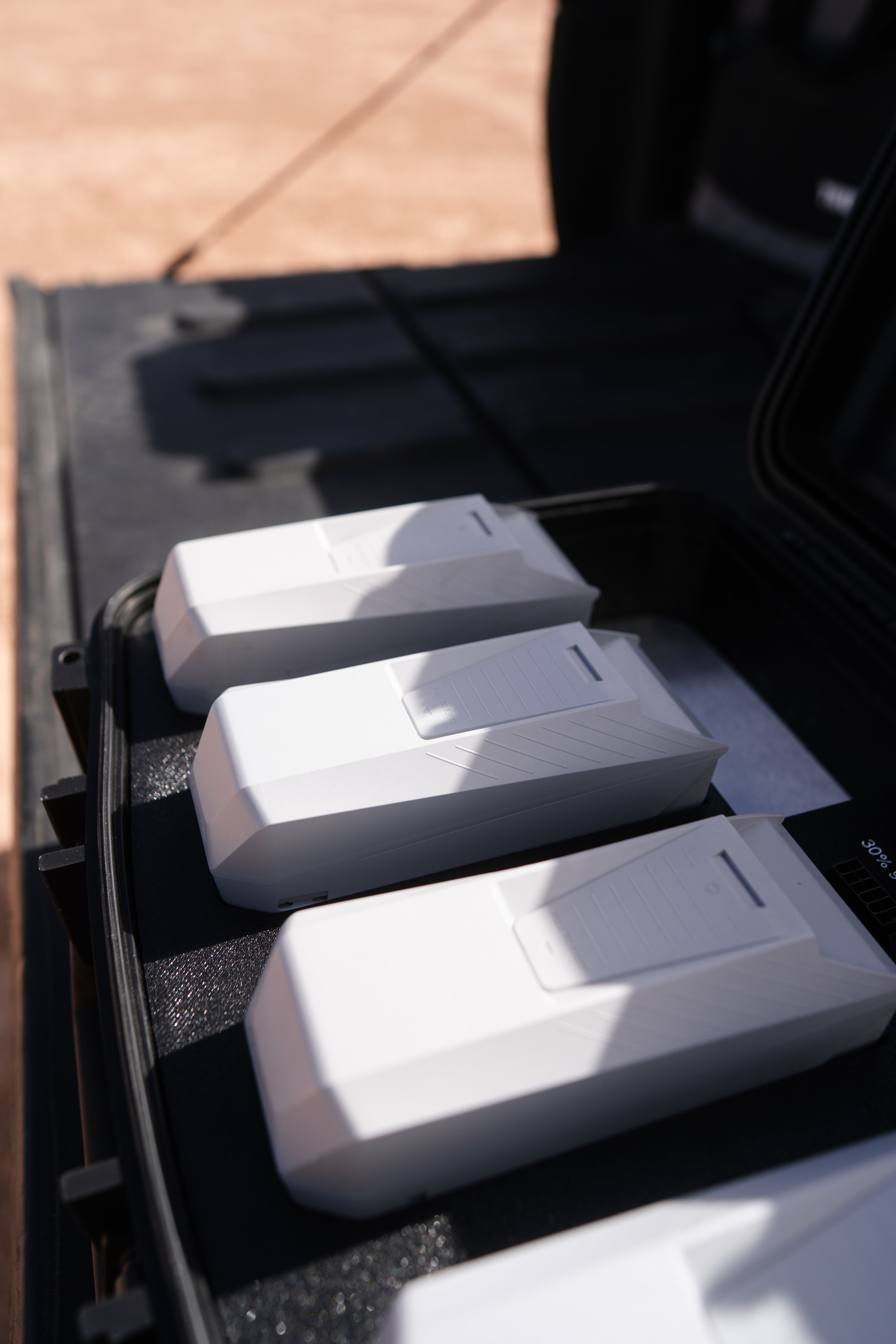
For a public safety drone program, batteries are the difference between an aircraft that launches in ninety seconds and one that sits in the case while a scene develops. Pursuits, missing-person searches, fire overwatch, and disaster response do not wait for a charge cycle. This playbook covers how police, fire, and EMS drone teams keep batteries ready around the clock.
The readiness problem
Most departments size their battery fleet for the average call, then hit a long incident, a structure fire that runs six hours, an overnight search, and discover the math fails: a two-battery rotation with a one-at-a-time charger means the drone spends more time grounded than flying. Buying more batteries helps, but batteries age, need maintenance cycles, and tie up budget. The higher-leverage fix is charging four batteries at once, wherever the incident is.
Charge staging: not every battery should sit at 100%
Lithium flight batteries stored fully charged degrade faster, which is why DJI and other manufacturers build auto-discharge into their packs. The practical pattern for readiness is staging: keep go-bag batteries at storage-friendly levels day to day, then top the working set to full as you deploy. Multi-mode chargers make this workable. The Matrice 4T PRCS, for example, offers 50%, 90%, and 100% charge modes, so the same unit handles storage staging and full mission prep.
Charging at the incident, not back at the station
A rapid field charger turns any command post or staging area into a battery depot:
- Four batteries plus USB accessories simultaneously, with a full set back in roughly 45 to 60 minutes
- 100% duty cycle, rated for continuous charging across a 24-hour operational period
- Runs on what you already have: a command-vehicle inverter, a generator (pure or modified sine wave), or a portable power station. As a sizing rule, allow 500 to 1000W of continuous power per charger depending on the model; see our generator and inverter sizing guide
- Hard-case construction: impact-resistant, watertight, and dustproof, so it rides in the truck full time
Chargers for common public safety platforms
Rapid charging systems are model-specific. The four we see most in public safety fleets:
- DJI Matrice 4T PRCS, for the current workhorse enterprise platform
- Autel EVO Max 4T/N PRCS, for night ops and SAR fleets
- DJI Mavic 3 PRCS, covering Mavic 3E and 3T patrol drones
- Parrot ANAFI USA PRCS, for NDAA-compliant programs
Skydio agencies are covered too: the Skydio X10 PRCS brings the same four-at-a-time charging to X10 fleets.
All are made in the USA in Colorado Springs and carry a lifetime warranty, which matters when the unit lives in a response vehicle. The full lineup, covering eighteen platforms, is in our Portable Power & Field Charging collection.
A simple battery SOP to start from
Departments that run smooth battery programs tend to follow the same outline: number every battery and rotate them evenly; log cycles and retire packs on schedule; stage storage charge levels between calls; stage the rapid charger and power source in the response vehicle, not the station; and assign battery turnaround to a specific role during extended incidents. Pair that SOP with four-at-a-time charging and battery availability stops being the limiting factor on your program.
For the broader gear picture, start with how to charge drone batteries in the field. And if you are scoping equipment for a department purchase, request a quote, we work with public safety agencies nationwide.
Share:
Made in the USA: Why We Carry Colorado Drone Chargers
DJI Agras T100 Review & Buyer's Guide 2026: The 100L Spray Drone