

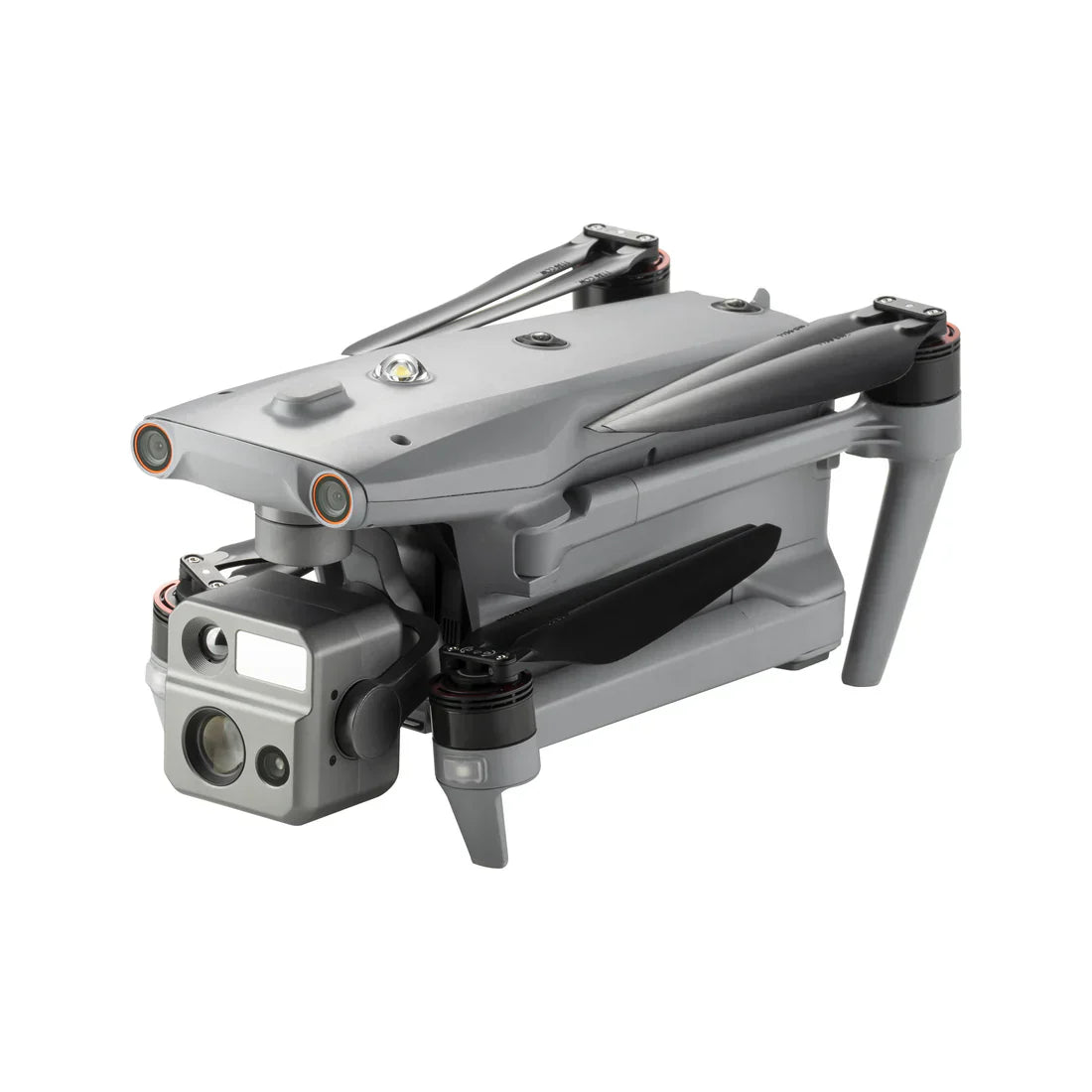
Quick Verdict
- Buy the 4T XE ($8,999) if: you need thermal inspection, daytime public safety, optical zoom, or mapping capability
- Buy the 4N ($12,599) if: your primary mission is complete-darkness nighttime operations where active lighting is not acceptable
- Not sure between EVO Max tiers? See the EVO Max Complete Buyer's Guide or compare down to the EVO II V3 series
The EVO Max 4T XE and EVO Max 4N are built on identical aircraft with different sensor payloads. The aircraft, transmission system, wind resistance rating, and accessories ecosystem are the same. The decision is entirely about which sensor profile fits your primary mission. This guide makes that decision straightforward.
Head-to-Head Spec Comparison
| Spec | EVO Max 4T XE | EVO Max 4N |
|---|---|---|
| Price | $8,999 | $12,599 |
| Optical zoom | 10x optical, up to 160x digital | Optical zoom (model-specific) |
| Wide camera | 50MP | Yes |
| Thermal camera | 640x512 resolution | No |
| Low-light sensor | Standard | Starlight -- ISO 450,000 |
| Night processing | None | Moonlight Algorithm 2.0 |
| Laser rangefinder | Up to 1.2km | Yes |
| Transmission range | 20km | 20km |
| Flight time | Up to 42 min | Up to 42 min |
| Wind resistance | Level 12 | Level 12 |
| SLAM navigation | Yes | Yes |
| A-Mesh networking | Yes | Yes |
Camera Breakdown: What the Sensors Actually Do
EVO Max 4T XE: Four Sensors, One Mission Package
The 4T XE payload combines four distinct imaging systems. The 48MP zoom camera with 10x optical zoom allows target identification at standoff distances -- a pilot can confirm a person, vehicle, or infrastructure defect from hundreds of meters away without overflying. The 160x digital zoom extends this range further for observation at distance.
The 640x512 thermal layer adds heat signature detection across the same scene. For fire operations, this means seeing through smoke. For search and rescue, it means detecting body heat in dense vegetation or at night. For infrastructure inspection, it enables detection of thermal anomalies in power lines, solar arrays, and pipelines. The 1.2km laser rangefinder calculates precise distance and GPS coordinates for any object in frame -- a capability that directly supports tactical public safety operations and survey workflows.
The 50MP wide camera covers area mapping and broad situational awareness.
Bottom line for 4T XE: This is a multi-tool payload. A single drone can handle thermal inspection, optical zoom surveillance, area mapping, and coordinate acquisition in a single deployment. It is the right choice for the majority of public safety, inspection, and enterprise mapping missions.
EVO Max 4N: One Sensor, One Mission
The 4N is purpose-built for complete darkness. The Starlight camera achieves ISO 450,000 -- an extreme light sensitivity that allows the 4N to produce usable, detailed video in environments where the 4T XE's standard sensors see nothing. Moonlight Algorithm 2.0 processes the raw sensor output to reduce noise and enhance detail, producing clean imagery in what appears to be pitch-black conditions.
This capability has no equivalent in the 4T XE. Thermal sees heat signatures but not detail. The 4N Starlight sees the physical scene -- facial features, clothing, license plates, terrain -- in conditions where the human eye and standard cameras are completely blind. For nighttime law enforcement surveillance, covert SAR in unlit terrain, or persistent overwatch where active lighting would compromise the operation, the 4N does something the 4T XE fundamentally cannot.
Bottom line for 4N: If nighttime operations are your primary mission profile, the 4N is the correct tool. If they are occasional, the $3,600 premium is harder to justify.
The One Scenario Where the 4N Wins Decisively
Complete darkness at distance, without active lighting. The 4T XE's thermal camera detects heat signatures in darkness -- but heat signatures show body shape, not detail. If you need to identify a specific person, read a license plate, or confirm a scene description in conditions with no ambient light at all, the 4N's Starlight sensor is the only tool that delivers. This is the core use case for the 4N in law enforcement surveillance, hostage or missing person scenarios in unlit terrain, and covert infrastructure monitoring.
Three Scenarios Where the 4T XE Wins
1. Thermal inspection. Solar farms, power lines, pipelines, and building envelopes require a thermal camera to detect anomalies. The 4N has no thermal sensor. The 4T XE's 640x512 thermal is purpose-built for this work.
2. Daytime public safety. The 10x optical zoom and 160x digital zoom allow the 4T XE to identify suspects, vehicles, and objects at standoff distances in daylight. Combined with the laser rangefinder for coordinate acquisition, the 4T XE covers the majority of daytime law enforcement, fire, and emergency management operations more comprehensively than the 4N.
3. Mapping and survey. The 50MP wide camera and multi-sensor payload make the 4T XE the correct tool for photogrammetric mapping, area survey, and situational awareness documentation. The 4N is not designed for this use case.
The Price Premium: What $3,600 Gets You
The EVO Max 4N costs $3,600 more than the 4T XE. That premium buys exactly one capability: ISO 450,000 Starlight sensitivity with Moonlight Algorithm 2.0 processing. You lose the thermal camera, and you gain extreme low-light color video. For agencies where nighttime covert operations are a primary mission profile -- dedicated narcotics surveillance units, border security, certain SAR teams -- this is a straightforward trade. For general-purpose public safety teams that fly most missions in daylight or need thermal capability, the 4T XE delivers more value per dollar.
Interchangeable Gimbals: Future-Proofing Your Investment
One of the most practically important features of the EVO Max platform is that the 4T XE and 4N payloads are interchangeable on the same aircraft body. If you buy the 4T XE today and later determine your mission profile shifts toward nighttime operations, you can purchase the 4N payload separately and swap it onto the same aircraft. You are not locked into a single sensor system for the life of the drone. This is not a capability available on the DJI Matrice 30T or Matrice 4T.
Frequently Asked Questions
Does the EVO Max 4N have thermal capability?
No. The EVO Max 4N does not include a thermal camera. The 4N payload is built around the Starlight visible-light sensor for extreme low-light performance. If you need thermal capability, the EVO Max 4T XE is the correct choice.
Which EVO Max model is better for search and rescue?
It depends on the search conditions. For daytime SAR or searches where body heat detection is the primary requirement, the 4T XE's 640x512 thermal camera is the stronger tool. For nighttime SAR in unlit terrain where you need to visually identify a person rather than just detect a heat signature, the 4N's Starlight sensor delivers better results.
Can I use the EVO Max for precision mapping?
Yes, with the optional EVO Max RTK Module ($529). The RTK module adds centimeter-accurate positioning to the 4T XE for photogrammetric survey and precision mapping workflows.
What accessories work with both the 4T XE and 4N?
All EVO Max accessories are compatible with both models: the intelligent battery ($319), multi-charger ($145), RTK module ($529), speaker and spotlight bundle ($979), payload drop system ($399), and the EVO Nest autonomous dock ($20,362).
Share:
Best Police Drones for Sale in 2026: Law Enforcement Buyer's Guide
DJI Zenmuse H30T Review: Worth $11,610 on a Matrice 400?