

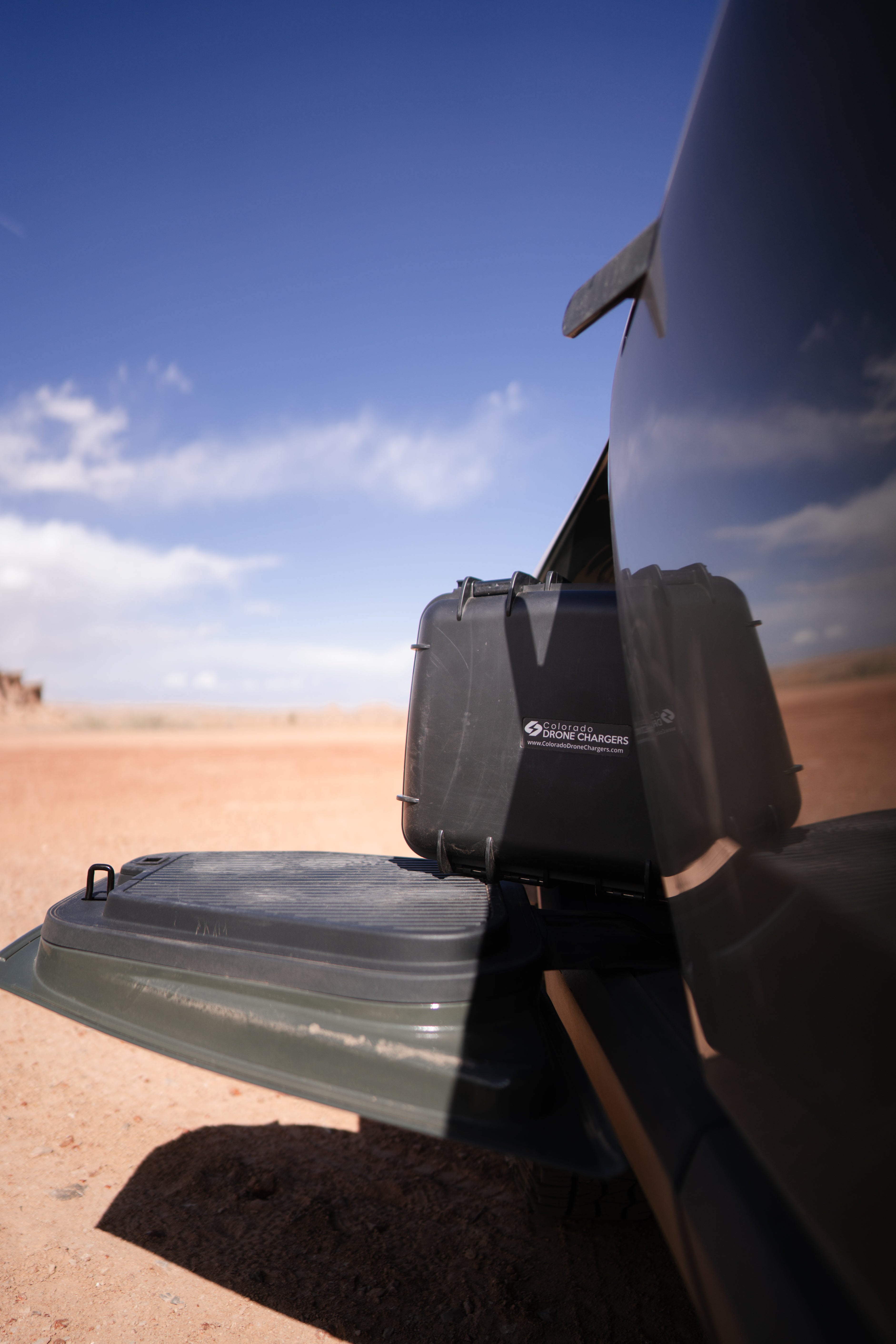
Yes, you can charge drone batteries from a generator or an inverter, as long as your charging system is designed for it. Purpose-built field chargers like the Colorado Drone Chargers Portable Rapid Charging Systems (PRCS) run on both pure and modified sine wave power sources, which covers virtually every generator and vehicle inverter on the market. The two things you need to get right are the power source's wave type and its continuous wattage rating. Here is how to size both.
Pure vs. modified sine wave: does it matter?
It depends entirely on your charger. Many consumer drone chargers and stock charging hubs are designed for clean household power and can behave unpredictably, or fail outright, on the rougher modified sine wave output that most budget inverters and portable generators produce. Field-oriented charging systems are built to accept both. Every Colorado Drone Chargers PRCS is rated for pure and modified sine wave power sources, so an inexpensive open-frame generator or a basic vehicle inverter works fine.
How many watts do you need?
Size your generator or inverter to the charger's continuous power requirement, not its peak rating, and multiply by the number of chargers you want to run at once. Manufacturer guidance for three popular systems:
| Charging system | Recommended continuous power (per unit) |
|---|---|
| DJI Mavic 3 PRCS | 500W |
| DJI Matrice 4T PRCS | 650W |
| Autel EVO Max 4T/N PRCS | 1000W |
The math scales linearly: running three Matrice 4T chargers at once means at least 1,950W of continuous power. A common field setup is a 2,000 to 3,000W inverter generator powering two or three chargers, with headroom to spare. Continuous power recommendations for every model in the lineup are listed on each product page in our Portable Power & Field Charging collection.
Charging drone batteries from a vehicle
Vehicles make excellent charging platforms with two cautions. If you wire an inverter directly to the battery, confirm your alternator is rated for the draw, or you will slowly kill the vehicle battery during long charge sessions. If you use a built-in outlet (many trucks and SUVs now offer 110V outlets, and EVs like the Rivian offer substantial onboard AC power), check the outlet's wattage rating in your owner's manual against the charger's continuous requirement before plugging in.
What about portable power stations?
Battery power stations are the quietest option and pair naturally with rapid chargers: no fuel, no fumes, no noise around the crew. The same sizing rule applies, with one addition: check the power station's output wattage and its capacity in watt-hours. A 60-minute charge cycle on a 650W charger consumes roughly 650Wh, so a 1,500Wh power station covers about two full four-battery charge cycles on a Matrice 4T system.
The bottom line
Generator, inverter, vehicle outlet, or power station: all of them can keep your drone batteries charged in the field if your charging system accepts modified sine wave power and your source meets the continuous wattage requirement. For the full field-charging playbook, read how to charge drone batteries in the field, or find the rapid charger built for your aircraft in the Portable Power & Field Charging collection.
Share:
DJI Matrice 4T Battery Charging Guide: Charging Hub vs. Portable Rapid Charger
Made in the USA: Why We Carry Colorado Drone Chargers