

For commercial drone crews, the limiting factor on a long day is rarely the aircraft. It is the batteries. Whether you are mapping a quarry, running public-safety overwatch, or inspecting a power line, one question decides how much you get done: how fast can you get charged packs back in the air?
This guide covers how to charge your drone batteries in the field, the gear that makes it possible, and how to cut your turnaround time between flights.
Why field charging matters
Most stock drone chargers are built for the office, not the field. They charge one or two batteries at a time, often sequentially, and assume you have a wall outlet nearby. On a real job site, none of those assumptions hold. A two-pilot crew can drain six to eight batteries before the first set is even close to full, and every minute spent waiting on power is a minute the aircraft is on the ground.
The fix is a charging setup designed around three realities of field work: speed, capacity, and independence from the grid.
The fastest option: a portable rapid charging system

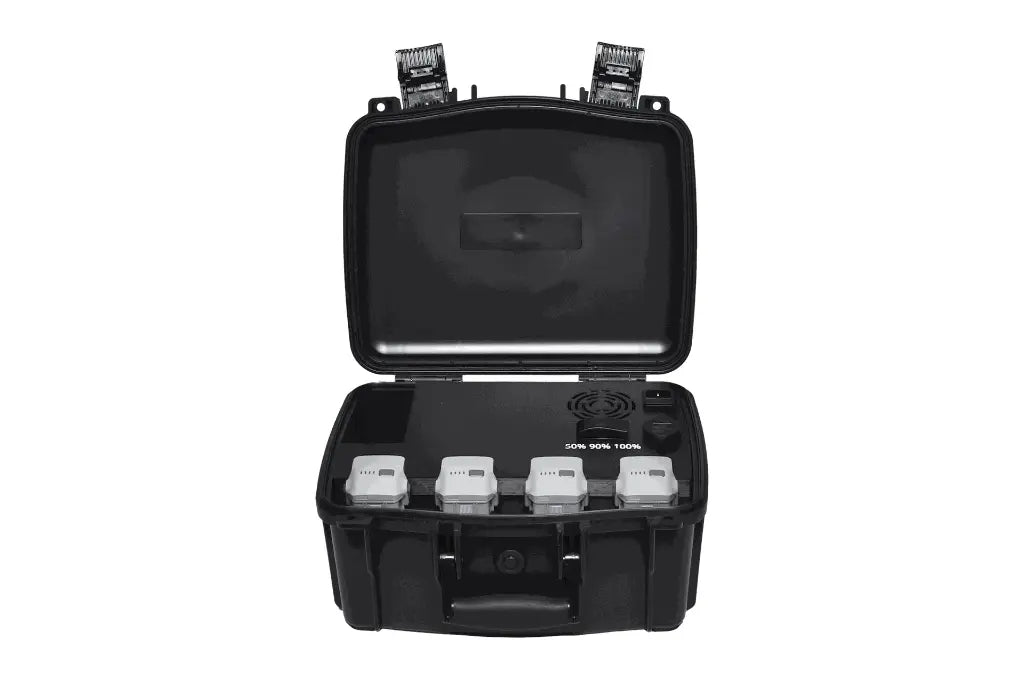
A portable rapid charging system, or PRCS, is purpose-built to keep crews flying. The Colorado Drone Chargers PRCS line charges four batteries and two USB accessories simultaneously, not one after another, with most systems refilling a full set in 45 to 65 minutes. Each unit is model-specific, built and tuned for one drone platform, which is what allows the fast, safe charge rates: every system manages current, voltage, and temperature with multi-fan cooling, and runs at a 100% duty cycle so you can charge continuously around the clock.
These chargers are made in the USA in Colorado Springs, housed in impact-resistant, watertight hard cases, and backed by a lifetime warranty.
Powering your charger off-grid
A fast charger is only useful if you can power it. A quality PRCS runs off almost anything:
- Shore power when you have it (a wall outlet at a hangar or office).
- A vehicle inverter for charging out of a truck or SUV between sorties.
- A field generator for all-day operations far from the grid. Pure or modified sine wave both work.
- A portable power station for silent, fume-free charging. This is the cleanest off-grid option and pairs perfectly with a rapid charger.
Sizing the power source correctly matters more than the type. We break down sine wave compatibility, continuous wattage requirements per charger, and vehicle charging in our guide: Can you charge drone batteries from a generator or inverter?
Find the charger built for your drone
Because a PRCS is tuned to a specific aircraft, you choose the charger that matches your platform. Every system below charges four batteries simultaneously:
| Drone platform | Rapid charger | Avg. charge time (20-90%) |
|---|---|---|
| DJI Matrice 4T | Matrice 4T PRCS | 60 min |
| DJI Mavic 3 / 3E / 3T | Mavic 3 PRCS | 55 min |
| DJI Mavic 2 | Mavic 2 PRCS | 45 min |
| DJI Phantom 4 | Phantom 4 PRCS | 50 min |
| DJI Inspire 2 / Matrice 200 | Inspire 2 / M200 PRCS | 50-75 min |
| DJI Inspire 1 / Matrice 600 | Inspire 1 / M600 PRCS | 50-75 min |
| DJI Avata | Avata PRCS | 60 min |
| DJI Avata 2 | Avata 2 PRCS | 60 min |
| DJI Ronin 4D / Ronin 2 | Ronin 4D/2 PRCS | ~60 min |
| Autel EVO Max 4T/4N | EVO Max 4T/N PRCS | 60 min |
| Autel EVO II | EVO II PRCS | 65 min |
| Skydio X10 | Skydio X10 PRCS | ~60 min |
| Skydio X2 | Skydio X2 PRCS | 60 min |
| Freefly SL8 | Freefly SL8 PRCS | 65 min |
| Anzu Raptor | Anzu Raptor PRCS | 60 min |
| Parrot ANAFI USA | ANAFI USA PRCS | 55 min |
| Parrot ANAFI UKR | ANAFI UKR PRCS | 55 min |
| Teal Golden Eagle / Teal 2 | Teal GE / Teal 2 PRCS | 45 min |
Flying the DJI Matrice 4T? See the deep dive: DJI Matrice 4T battery charging, hub vs. rapid charger.
Build a complete field charging kit

The most reliable setup is simple: a model-specific rapid charger to refill four packs at a time, and a portable power station or generator to run it anywhere. Together they turn the biggest bottleneck in a field operation, battery turnaround, into a non-issue. Your crew flies, lands, swaps, and keeps working.
The bottom line
If your team is losing flight time to slow charging, the upgrade pays for itself fast. Start with the charger built for your aircraft, add a power station for off-grid days, and keep the mission moving. Shop drone field chargers and portable power at Global Drone HQ.
Share:
Autel EVO Max Accessories & Payloads Guide 2026
DJI Dock 3 vs Autel EVO Nest: Which Drone-in-a-Box Should You Buy? (2026)