

Unitree Robotics
Unitree R1-A7 Dual-Arm Robot (Desk-Mount & Mobile Base)
Overview
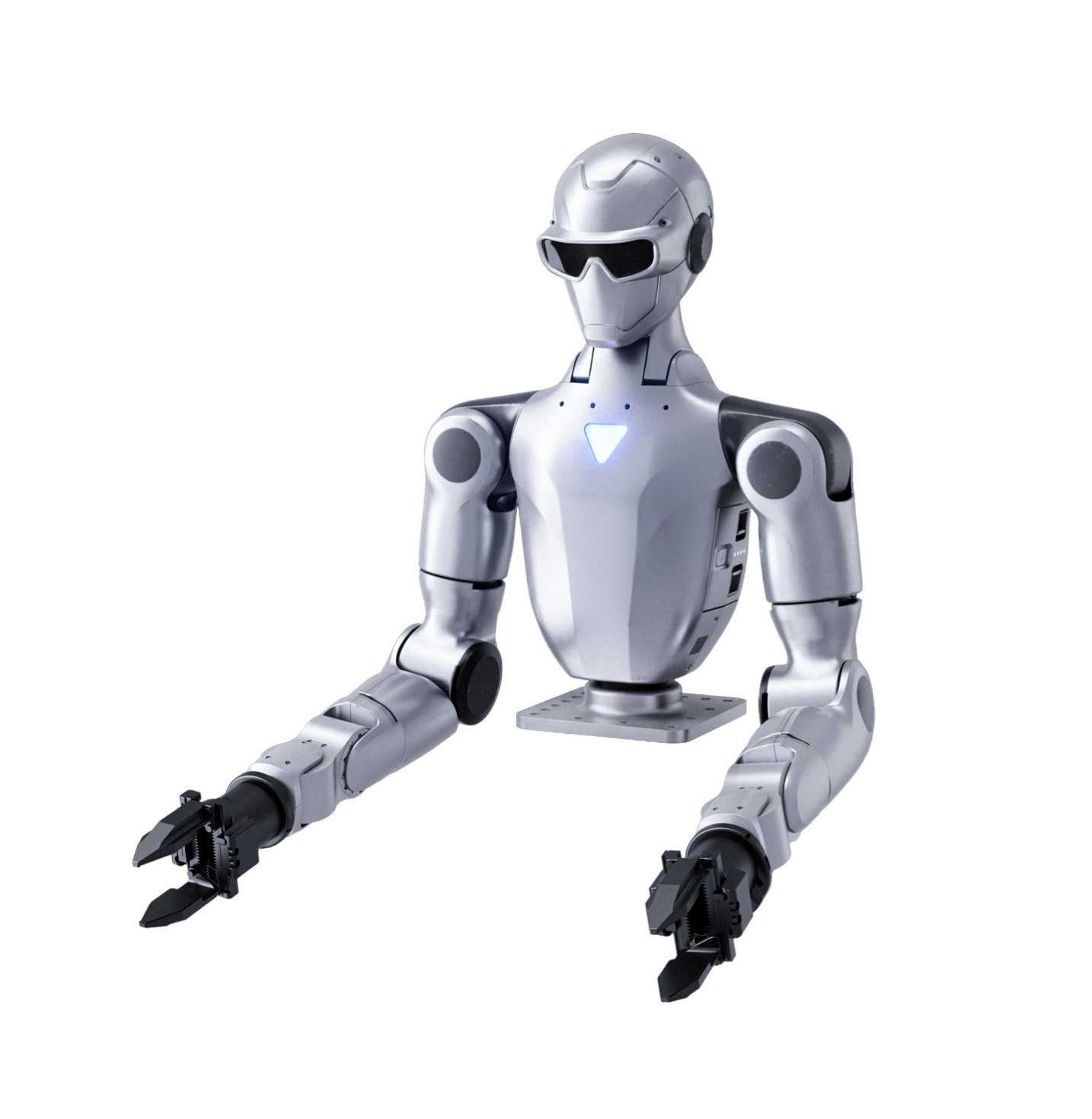
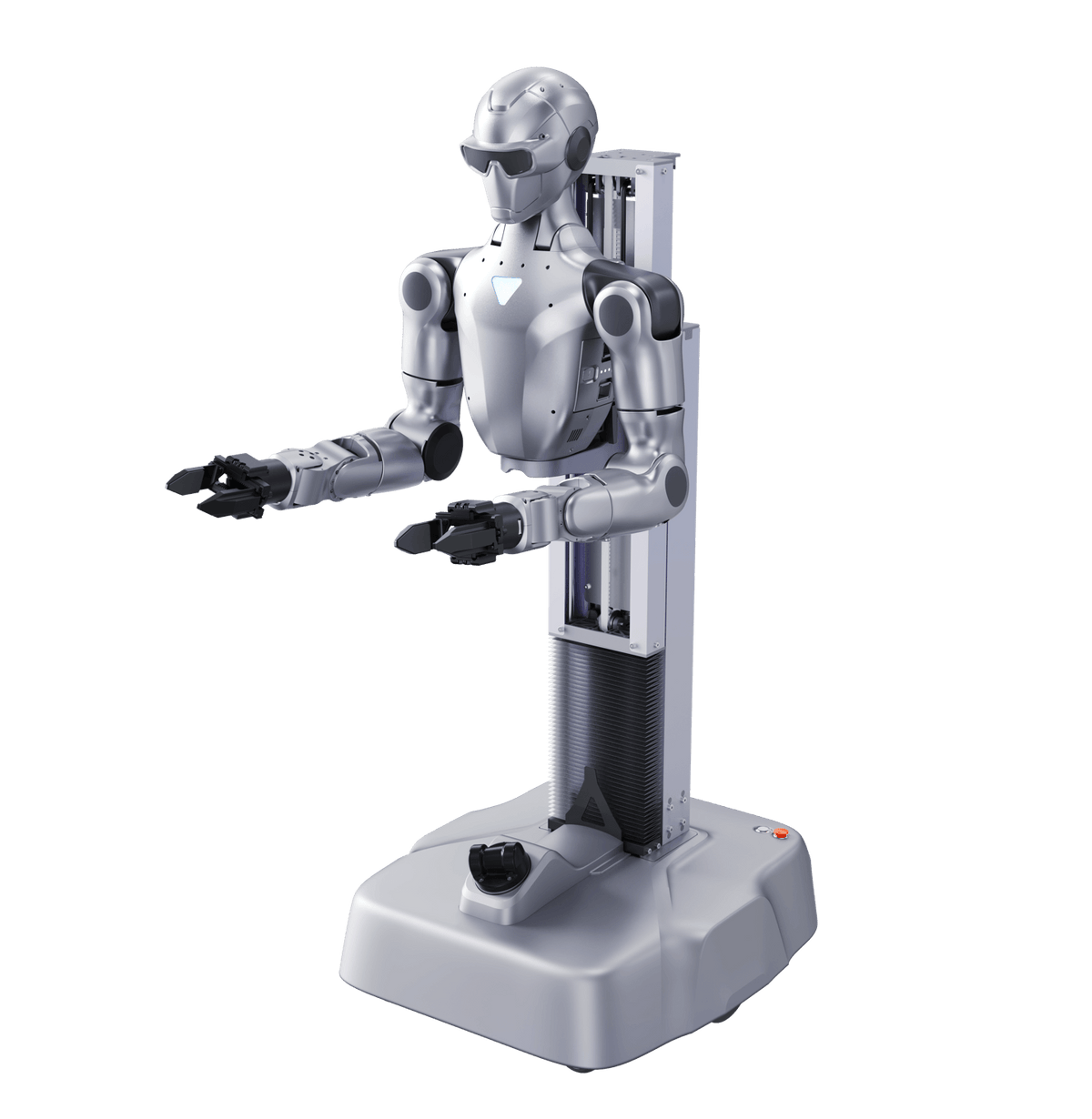
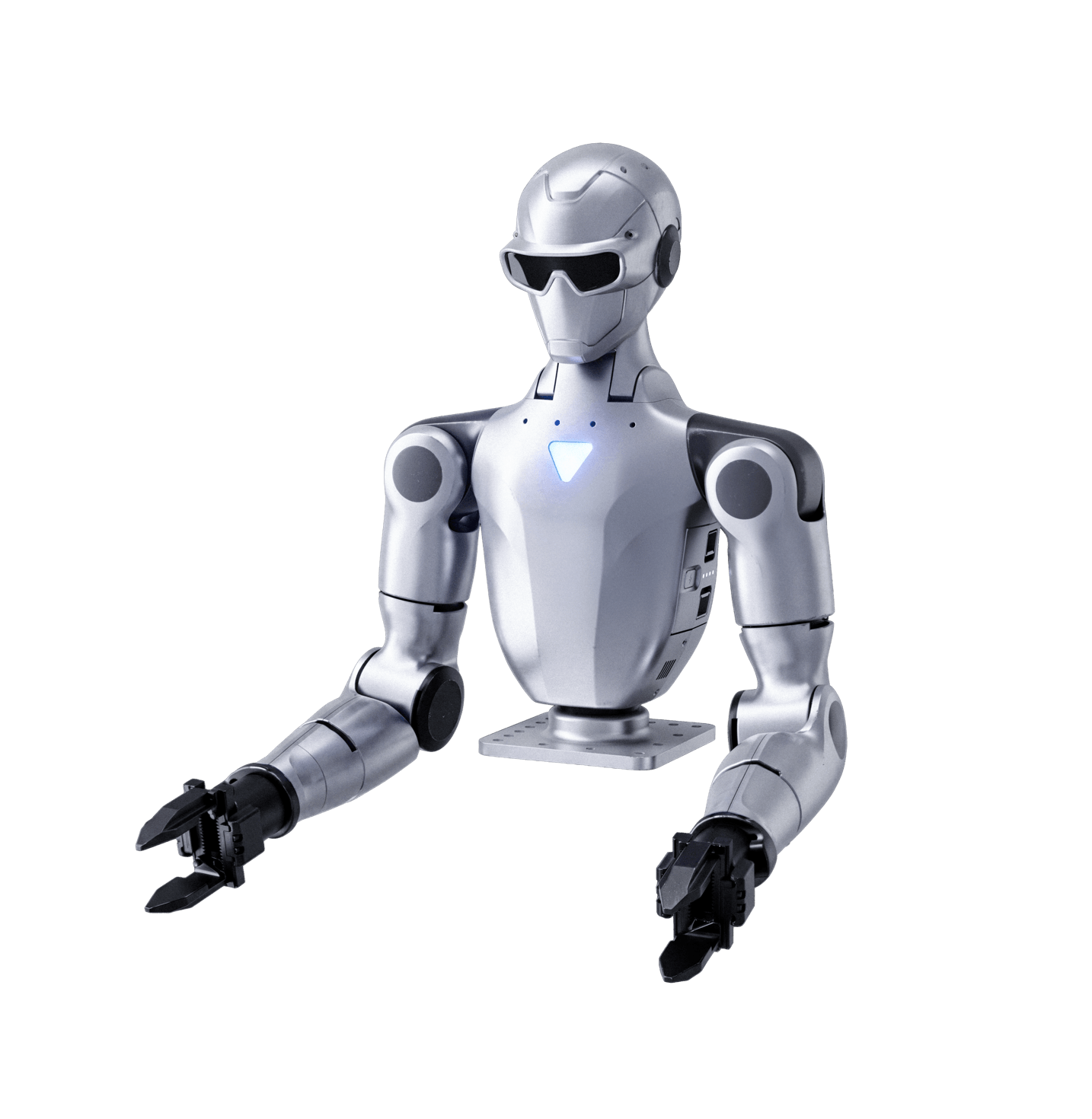
The Unitree R1-A7 is the 7-DoF-per-arm version of Unitree's dual-arm manipulation platform: two 7-DoF arms with 555 mm (21.9 in) of reach, a rotating waist and a 2-DoF sensor head. The extra joints per arm give it human-like redundancy for obstacle-aware trajectories and contact-rich manipulation research. Choose the desk-mount R1-A7, or the R1-A7-D, which mounts the torso on a wheeled mobile base with a powered lifting column and a chassis LiDAR for mobile manipulation. Every configuration is open for secondary development.
Specifications published by Unitree
| Spec | R1-A7 (desk-mount) | R1-A7-D (mobile base) |
|---|---|---|
| Dimensions | 835 x 357 x 190 mm (32.9 x 14.1 x 7.5 in) | 683 x 520 x 440 mm (26.9 x 20.5 x 17.3 in) collapsed, raised to 1,600 mm (63 in) |
| Weight | About 13 kg (29 lb) | About 32 kg (71 lb) |
| Degrees of freedom | 17 (7 x 2 arms, 1 waist, 2 head), or 19 counting the grippers | 20 (adds a 3-DoF wheeled chassis), or 22 counting the grippers |
| Arm payload | 2 to 4 kg (4.4 to 8.8 lb) per arm. Unitree states the figure varies a great deal with arm extension. | |
| Arm length (forearm + upper arm) | 555 mm (21.9 in) | |
| Shoulder torque | 60 Nm (44 lb-ft) maximum | |
| End-clamp accuracy | ±0.1 mm (±0.004 in) | |
| Sensing | Binocular head camera, 1280 x 720 RGB at 30 Hz and 544 x 448 depth at 10 Hz, 146° by 124° field of view | Same head camera plus a chassis LiDAR |
| Compute | 8-core CPU (body) plus 8-core CPU with 10 TOPS (head). Smart configurations add a 40 TOPS Orin Nano. Ultimate configurations (A7-D only) add a 100 TOPS Orin NX. | |
| Power | External supply standard, optional upper-body battery giving about 1.5 h | Removable chassis battery standard (about 1.5 h) plus external supply |
| Joint design | Crossed-roller and deep-groove ball bearings, hollow internal wiring, dual encoders on the arm joints, local air cooling | |
| Audio | 4-array microphone and dual 3 W speakers | |
| Wireless | Wi-Fi 6 and Bluetooth 5.2 | |
| Waist and head range | Waist yaw ±150°, head yaw ±115° and pitch ±36° | Waist yaw ±35°, head yaw ±115° and pitch ±36° |
| SDK | Yes, full secondary development support | |
| Warranty | 12 months, serviced through Toborlife in Mountain View, California | |
Unitree publishes no IP rating and no operating temperature range for this platform. Treat it as indoor laboratory equipment.
Choosing a Configuration
- No Hands: bring your own end effectors for custom research setups.
- Smart (40 TOPS): built-in Orin Nano compute plus your choice of hands: Dex1-1 V2 grippers (A), Dex3-1 three-finger force-controlled hands (B/C), BrainCo Revo 2 bionic hands (D/E), LinkerBot O6 six-DoF hands (F/G), or tendon-driven dexterous hands (H). Tactile versions add fingertip sensing.
- Ultimate (100 TOPS, R1-A7-D only): Orin NX compute for onboard VLA and policy inference with the same hand options.
Working at benchtop scale on a tighter budget? The Unitree R1-A5 offers 5-DoF arms from $4,290.
Who It's For
Manipulation labs that need kinematic redundancy, dual-arm imitation-learning and teleoperation data pipelines, embodied-AI startups, and industrial R&D teams prototyping bimanual assembly, sorting or inspection tasks.
Quotes and Purchase Orders
Request a formal quote for institutional procurement. We support university and government purchase processes.
Frequently Asked Questions
What does 7-DoF give me over the 5-DoF R1-A5?
Two extra joints per arm and 555 mm (21.9 in) of reach versus 420 mm (16.5 in). The added redundancy lets the arm reach a target from multiple elbow postures, which matters for obstacle avoidance, human-like demonstration data, and contact-rich tasks. If your research involves cluttered scenes or humanlike motion, the A7 is the better platform. For straightforward benchtop pick-and-place, the A5 saves budget.
Which hand option should I choose?
Dex1-1 V2 grippers (A) are the economical choice for pick-and-place data collection. Dex3-1 force-controlled three-finger hands (B/C) target dexterous manipulation, with tactile fingertips on the C version. BrainCo Revo 2 (D/E) and LinkerBot O6 (F/G) provide bionic, humanlike form factors, and tendon-driven hands (H) maximize dexterity. Tell us your research goals and we will match the configuration.
Can I program it?
Yes. Every configuration supports secondary development with development manuals and ecosystem support, and Smart and Ultimate configurations carry onboard NVIDIA compute (40 or 100 TOPS) for your own perception and policy models.
Is it authorized for use in the US?
We confirm the equipment authorization for your exact configuration before we quote it, in writing. You can check any FCC grant yourself at apps.fcc.gov/oetcf/eas. FCC equipment authorization is a separate question from NDAA procurement eligibility, so raise federal procurement rules with us first.
How long does delivery take?
Lead times vary by configuration and factory availability. We confirm the current lead time when you order or request a quote and keep you updated through delivery.
Do you accept purchase orders?
Yes. We support university, government and enterprise procurement with formal quotes, vendor registration, W-9 documentation, and purchase orders for verified institutions.
Explore the Unitree Lineup
Compare the R1-A5 with 5-DoF arms, add legs with the R1 Edu humanoid, or browse the complete Unitree collection.
US equipment authorization confirmed on your quote
Sourced through Toborlife, Unitree's authorized US distributor and warranty center
Freight quoted to your destination
Purchase orders and tax-exempt purchasing welcome

Degrees of freedom

Arm reach

Arm payload

Onboard AI compute

Mobile base sensing
Pairs well with
Questions about configuration, lead time or deployment? We reply within one business day.
-
Shipping and Delivery
Robots ship freight and insured to your dock or venue. Freight is quoted to your destination address and appears as a line item on your written quote. Lead time is confirmed in writing before you commit to a delivery date.
-
Support
You deal with Global Drone HQ directly, before and after the sale. We help you pick the right configuration, handle delivery, first-line troubleshooting and setup, and we coordinate anything that needs the service center rather than handing you an address overseas.
-
Warranty and Service
Toborlife is an authorized Unitree warranty and repair center in Mountain View, California, and handles complete-machine warranty service, repair or replacement of core components and factory-level diagnostics. Global Drone HQ is your first line for setup, routine troubleshooting and support. Units are sourced through Toborlife, Unitree's authorized US distributor.
-
Contact Us
Email daniel@globaldronehq.com or call (858) 906-5185. Purchase orders and tax-exempt purchasing are welcome for schools, universities and public agencies.
7 DoF Per Arm • 555 mm (21.9 in) Reach • 2 to 4 kg (4.4 to 8.8 lb) Per Arm • Full SDK Access • Quotes & POs Welcome
Dig Deeper
Arms, Waist and Head
- 7 degrees of freedom per arm, two arms, on low-inertia inner-rotor joint motors.
- 19 total degrees of freedom on the desk-mount R1-A7, and 22 on the R1-A7-D with its wheeled chassis.
- Forearm plus upper arm 555 mm (21.9 in) of reach.
- 2 to 4 kg (4.4 to 8.8 lb) per arm, and Unitree is explicit that the figure moves a long way with arm extension.
- 60 Nm (44 lb-ft) maximum shoulder torque, with end-clamp repeatability of ±0.1 mm (±0.004 in).
- Waist yaw ±150° on the desk-mount, ±35° on the mobile base. Head yaw ±115°, pitch ±36°.
- Crossed-roller and deep-groove ball bearings, hollow internal wiring, dual encoders on the arm joints, local air cooling.
Sensing, Compute and Interaction
- Binocular head camera, RGB at 1280 x 720 at 30 Hz and depth at 544 x 448 at 10 Hz.
- Binocular field of view 146° horizontal by 124° vertical, eye spacing 60 mm (2.4 in).
- 8-core CPU in the body and an 8-core CPU with 10 TOPS in the head as standard.
- Optional NVIDIA Orin module, 40 to 100 TOPS, for running your own perception and policy models on board.
- 4-array microphone and dual 3 W speakers for voice interaction.
- Wi-Fi 6 and Bluetooth 5.2. Optional wrist cameras. The R1-A7-D adds a chassis LiDAR.
- Open interfaces for the underlying system, the arms, audio, lighting and vision, with full secondary development support.
Mounting, Power and Honest Limits
- R1-A7 desk-mount measures 835 x 357 x 190 mm (32.9 x 14.1 x 7.5 in) and weighs about 13 kg (29 lb).
- R1-A7-D on the mobile base is 683 x 520 x 440 mm (26.9 x 20.5 x 17.3 in) collapsed and rises to 1,600 mm (63 in), at about 32 kg (71 lb).
- About 1.5 hours on battery. Both versions also run on external power, which is how most benchtop work is done.
- Unitree publishes no IP rating and no operating temperature range for this platform. Treat it as indoor laboratory equipment and we will not tell you otherwise.
- This is a torso, not a humanoid. It does not walk. If your work needs legs, the R1 Edu is the machine.
- The arms are powerful and the structure is complex. Unitree asks operators to keep a real safety distance. Plan your workcell accordingly.
- 12-month manufacturer warranty, serviced through Toborlife in Mountain View, California.
Compare the R1 Research Platforms
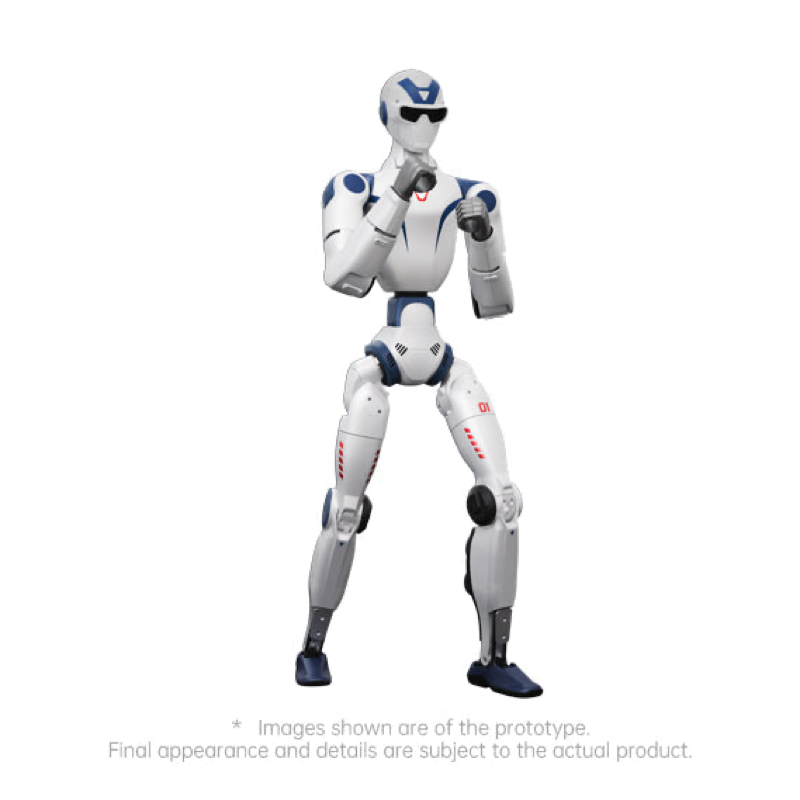
The A5 and the A7 are the same torso with different arms. The R1 Edu is the legged humanoid built on the same 420 mm (16.5 in) arm. Unitree does not publish a speed, an IP rating or a temperature range for any of them, so those rows say so rather than guess.
Weight
About 13 kg (29 lb) desk-mount, about 32 kg (71 lb) on the mobile base
Weight
About 11 kg (24 lb) desk-mount, about 30 kg (66 lb) on the mobile base
Weight
About 29 kg (64 lb) with battery
Top Speed
Not published by Unitree
Top Speed
Not published by Unitree
Top Speed
Not published by Unitree
Rated Payload
2 to 4 kg (4.4 to 8.8 lb) per arm, varies with arm posture
Rated Payload
2 to 4 kg (4.4 to 8.8 lb) per arm, varies with arm posture
Rated Payload
About 2 kg (4.4 lb) per arm
Protection
Not published by Unitree, treat as indoor laboratory equipment
Protection
Not published by Unitree, treat as indoor laboratory equipment
Protection
Not published by Unitree, treat as indoor laboratory equipment
Endurance
About 1.5 h on battery, or run continuously on external power
Endurance
About 1.5 h on battery, or run continuously on external power
Endurance
About 1 h on the quick-release smart battery
Locomotion
Fixed base, or wheeled mobile base with a powered lifting column on the A7-D
Locomotion
Fixed base, or wheeled mobile base with a powered lifting column on the A5-D
Locomotion
Legged, 6 degrees of freedom per leg
Operating Temp
Not published by Unitree
Operating Temp
Not published by Unitree
Operating Temp
Not published by Unitree
Best For
Cluttered scenes and humanlike motion where redundant joints matter
Best For
Benchtop bimanual manipulation and imitation-learning data collection
Best For
Legged whole-body research where the robot has to walk to the task
Price
From $4,890
Price
From $4,290
Price
$18,900
FAQs
Is the R1-A7 authorized for use in the US?
We confirm the equipment authorization for your exact configuration before we quote it. Unitree's published US grants under grantee code 2A5PE cover the quadrupeds, the G1, the R1 legged humanoid and the H2. None of the grants on file names the R1-A dual-arm platform, so we verify the authorization that applies to the unit you are buying, in writing, rather than pointing you at somebody else's FCC ID. You can check any grant yourself at apps.fcc.gov/oetcf/eas. FCC equipment authorization is a separate question from NDAA procurement eligibility, so if you are buying under a federal procurement rule, raise that with us first.
How long does it run on a charge?
About 1.5 hours on the battery. The desk-mount ships with an external power supply as standard and the battery is optional, so most benchtop programs simply leave it plugged in and never think about runtime. The mobile-base version carries a removable chassis battery and can also take external power.
How is the R1-A7 different from the R1-A5?
7 degrees of freedom per arm and 555 mm (21.9 in) of reach, against 5 degrees of freedom and 420 mm (16.5 in) on the R1-A5. The extra joints buy you redundancy, which means the arm can reach the same point from more than one elbow posture. That matters for obstacle avoidance in cluttered scenes and for demonstration data that looks humanlike. For straightforward benchtop pick-and-place it is budget you do not need to spend. The R1-A7 starts at $4,890 and the R1-A5 at $4,290.
How much can each arm carry, and what can I bolt onto it?
2 to 4 kg (4.4 to 8.8 lb) per arm, and Unitree states plainly that the number varies a great deal with how far the arm is extended. The wrist takes a two-finger gripper, a three-finger force-controlled hand or a five-finger dexterous hand, and the end interfaces are open if you are building your own. The No Hands configuration exists for exactly that.
Desk-mount or mobile base?
The desk-mount R1-A7 is a fixed workcell: it costs less and it is the right answer if your tasks stay on one bench. The R1-A7-D puts the same torso on a wheeled chassis with a powered lifting column that raises it to 1,600 mm (63 in), plus a chassis LiDAR, so it can navigate a lab and work at varying heights. Buy the mobile base for mobile manipulation research, not for the extra height alone.
Do you accept purchase orders?
Yes. We work with universities, research institutes and public agencies regularly and accept purchase orders and tax-exempt purchasing. Tell us what your procurement office needs and we will format the quote to match, including vendor registration and W-9 documentation.