

AgiBot Robotics
AgiBot D1 Pro and D1 Edu Quadruped Robot
The D1 Pro and D1 Edu are the same robot with one decisive difference: secondary development is available only on the Edu version. Both are compact, fast, reinforcement-learning-driven quadrupeds trained on tens of millions of data points, so they handle grass, gravel, and uneven ground with adaptive balance and anti-tipping. Both weigh 15.5 kg (34 lb), hit 3.5 m/s (7.8 mph), climb 16 cm (6.3 in) stairs continuously, and carry 5 kg (11 lb).
The difference is what you are allowed to build on top. The D1 Pro is a finished product: you operate it, you do not extend it. The D1 Edu exposes standardized expansion interfaces, Ethernet, USB, power, SBUS, and UART, and supports secondary development and custom modification, including mounting LiDAR, RGB-D cameras, and other payloads. If your buyers are students, researchers, or anyone who intends to write code against the platform, buy the Edu. If you want a demonstration and engagement robot that works out of the box, the Pro saves $2,600.
Choosing a Configuration
| Configuration | Secondary development | Expansion ports | Best for | Price |
|---|---|---|---|---|
| AgiBot D1 Pro | Not included | Not included | Demonstrations, events, marketing, entertainment | $4,599 |
| AgiBot D1 Edu | Yes, with SDK | Ethernet, USB, power, SBUS, UART | Classrooms, university labs, robotics programs | $7,199 |
Configurations per the AgiBot partner sheet. Secondary development features are available only in the D1 Edu version.
Key Highlights
- Reinforcement-learning motion control trained on tens of millions of data points, with adaptive balance and anti-tipping on grass, gravel, and uneven ground.
- 2 kW/kg peak power density from AgiBot's own joint system, which is what allows a 15.5 kg (34 lb) robot to sustain 3.5 m/s (7.8 mph) and a 35 cm (14 in) vertical jump.
- 5 kg (11 lb) effective payload for sensors, cameras, or demonstration hardware.
- 16 cm (6.3 in) continuous stair climbing and a 30° standard climbing angle, up to 40° maximum.
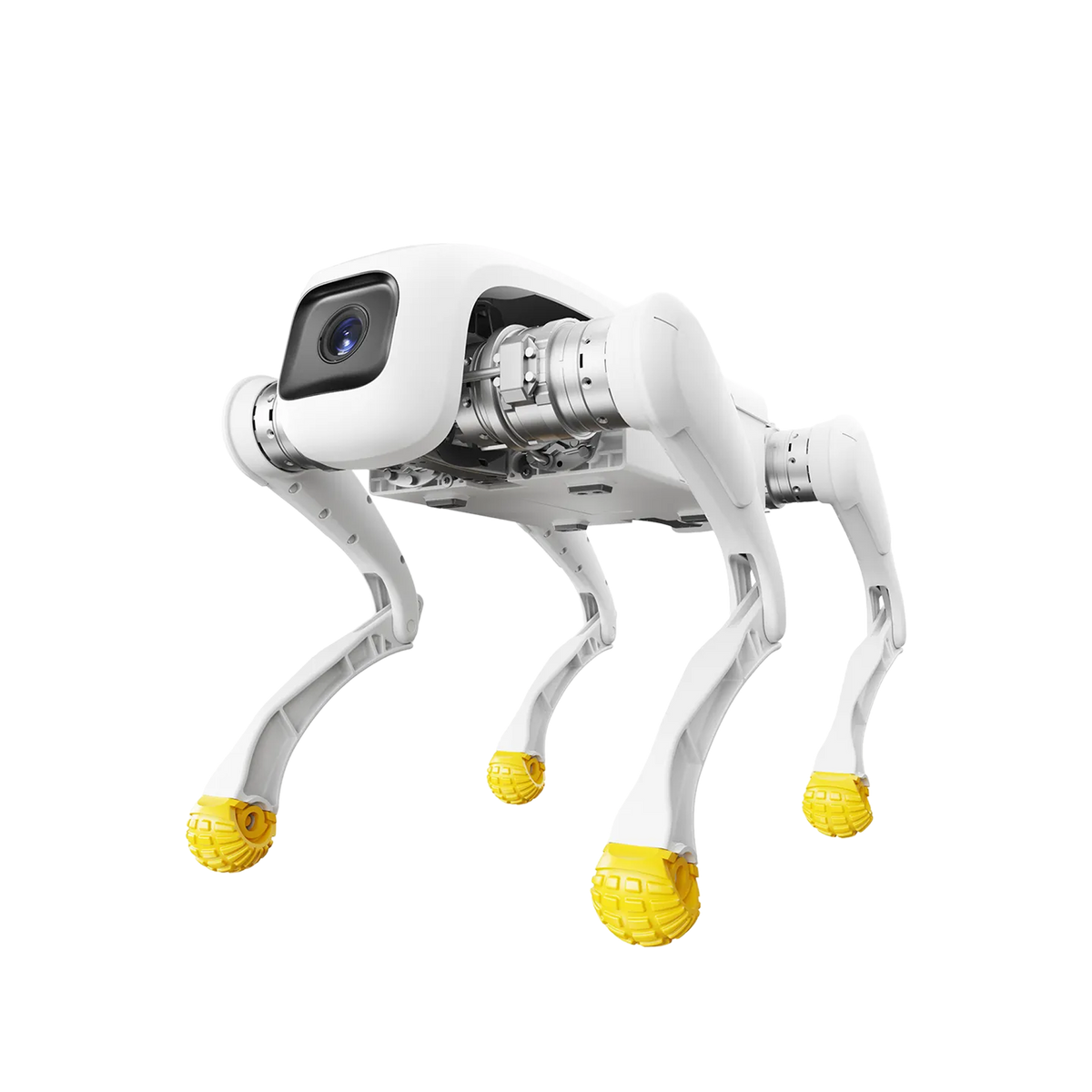
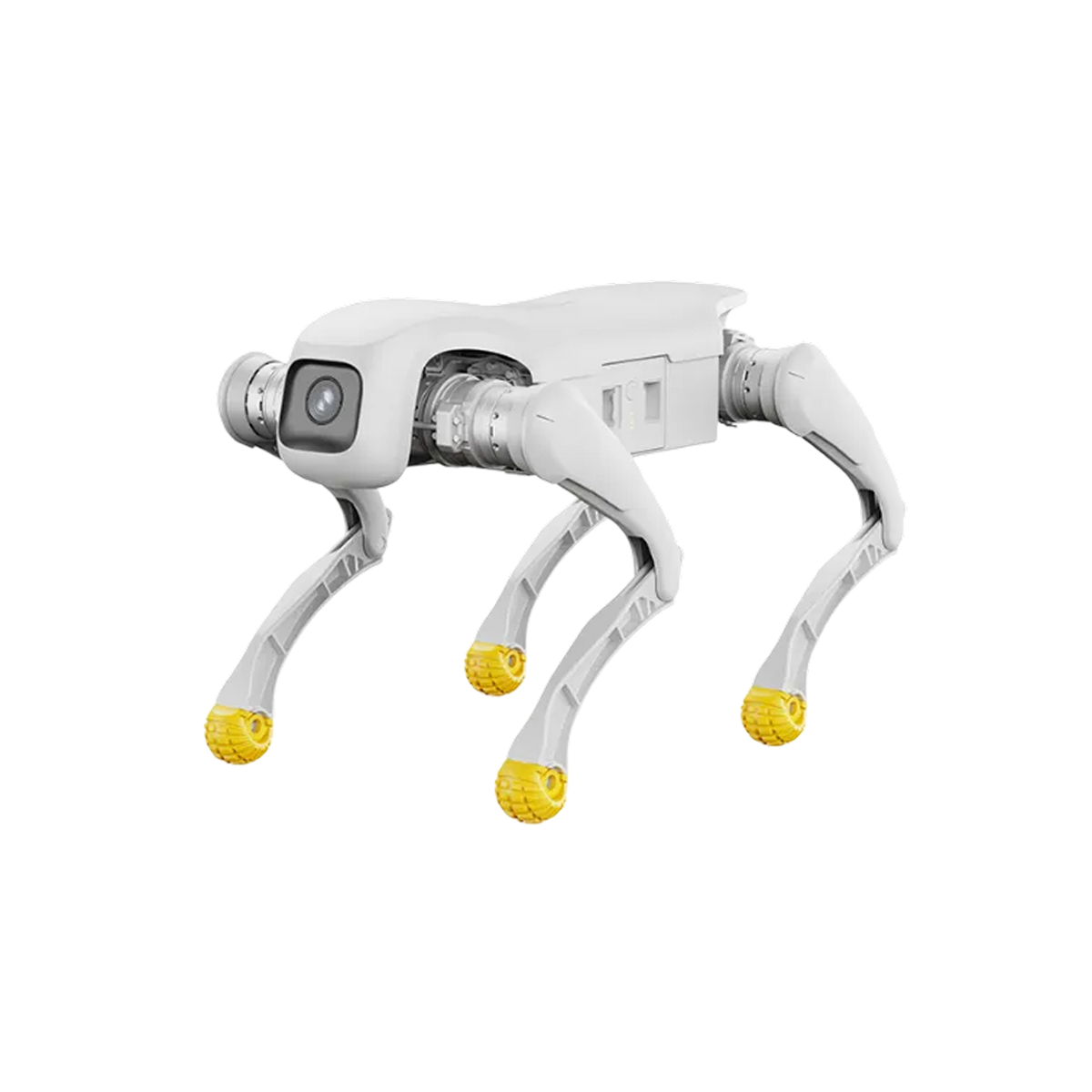
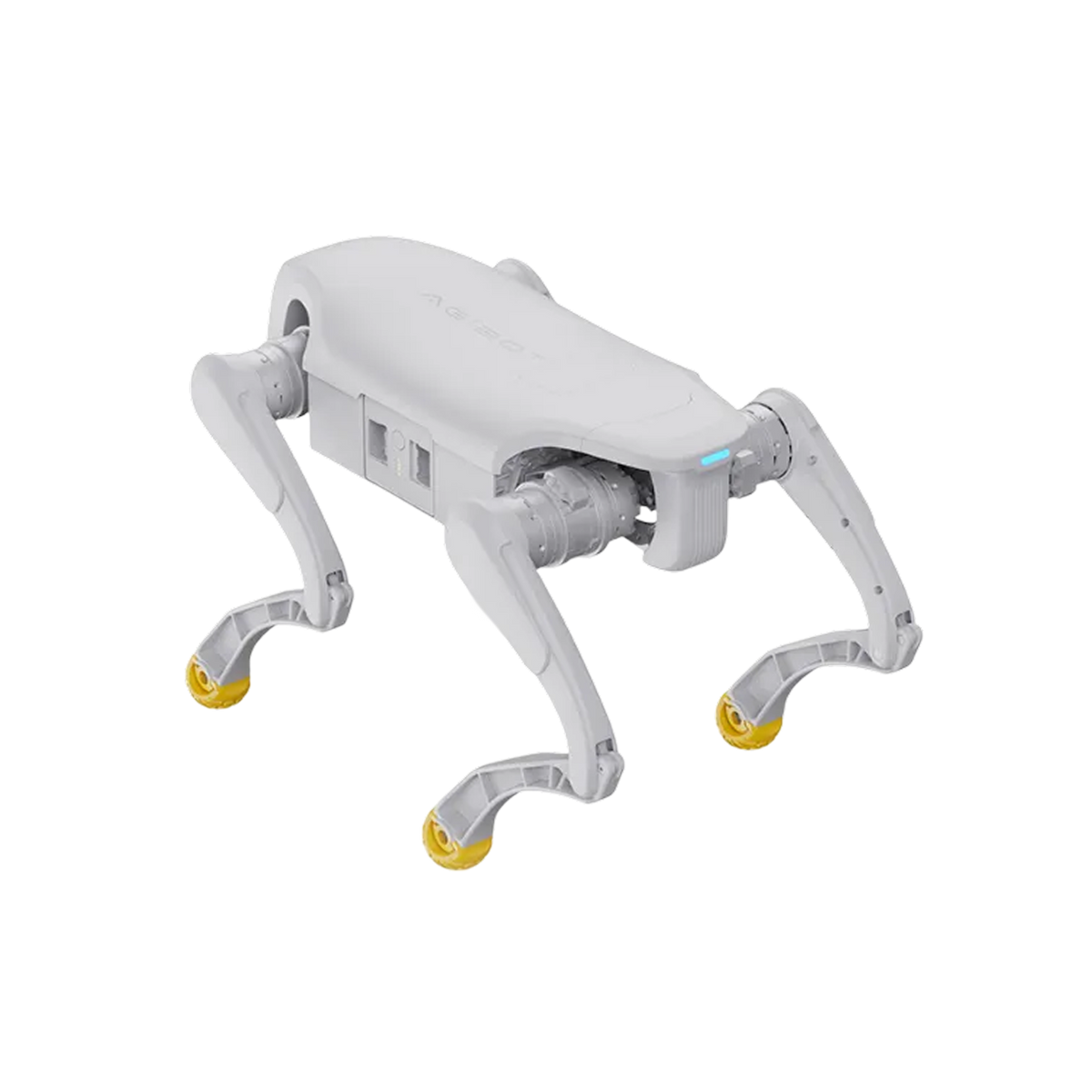
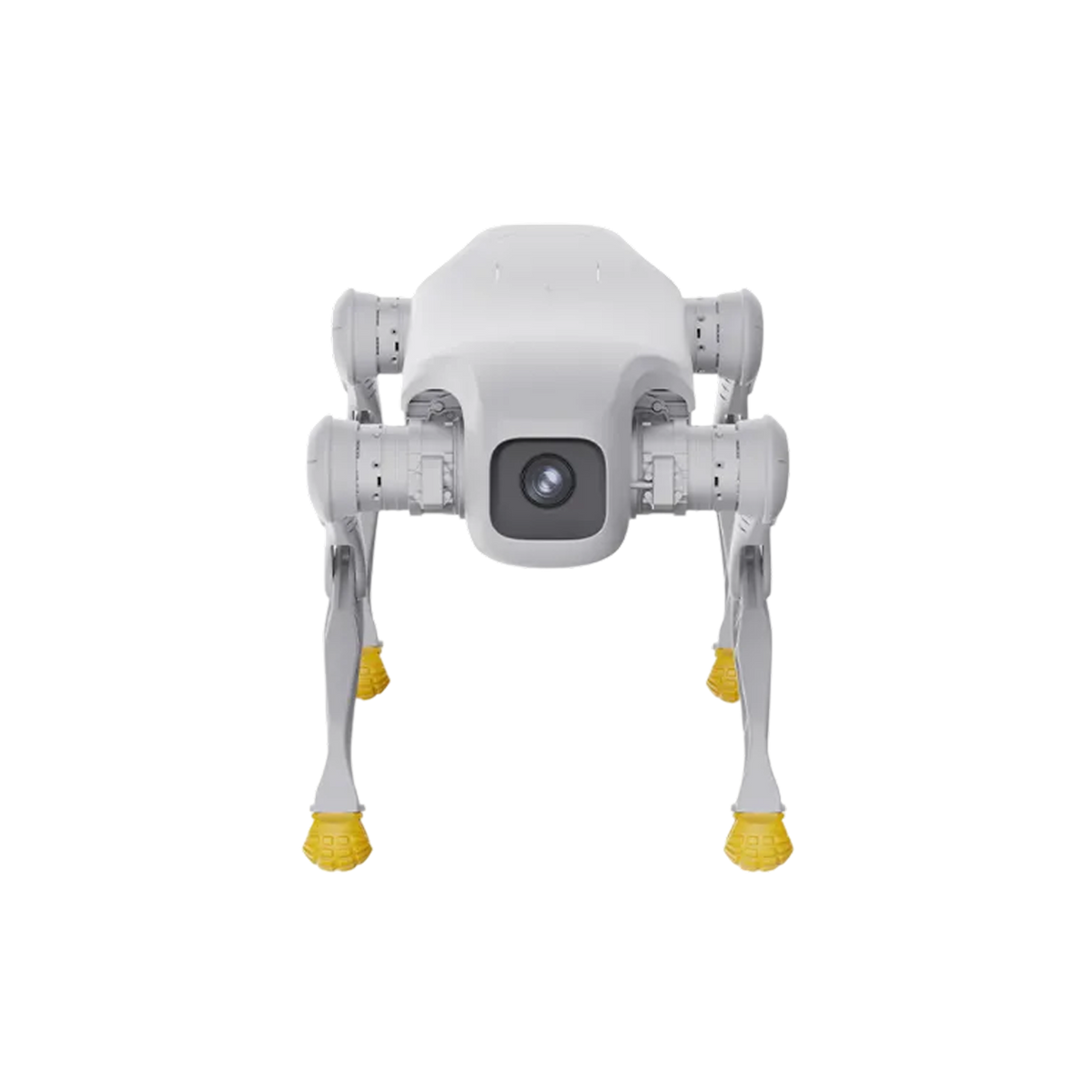
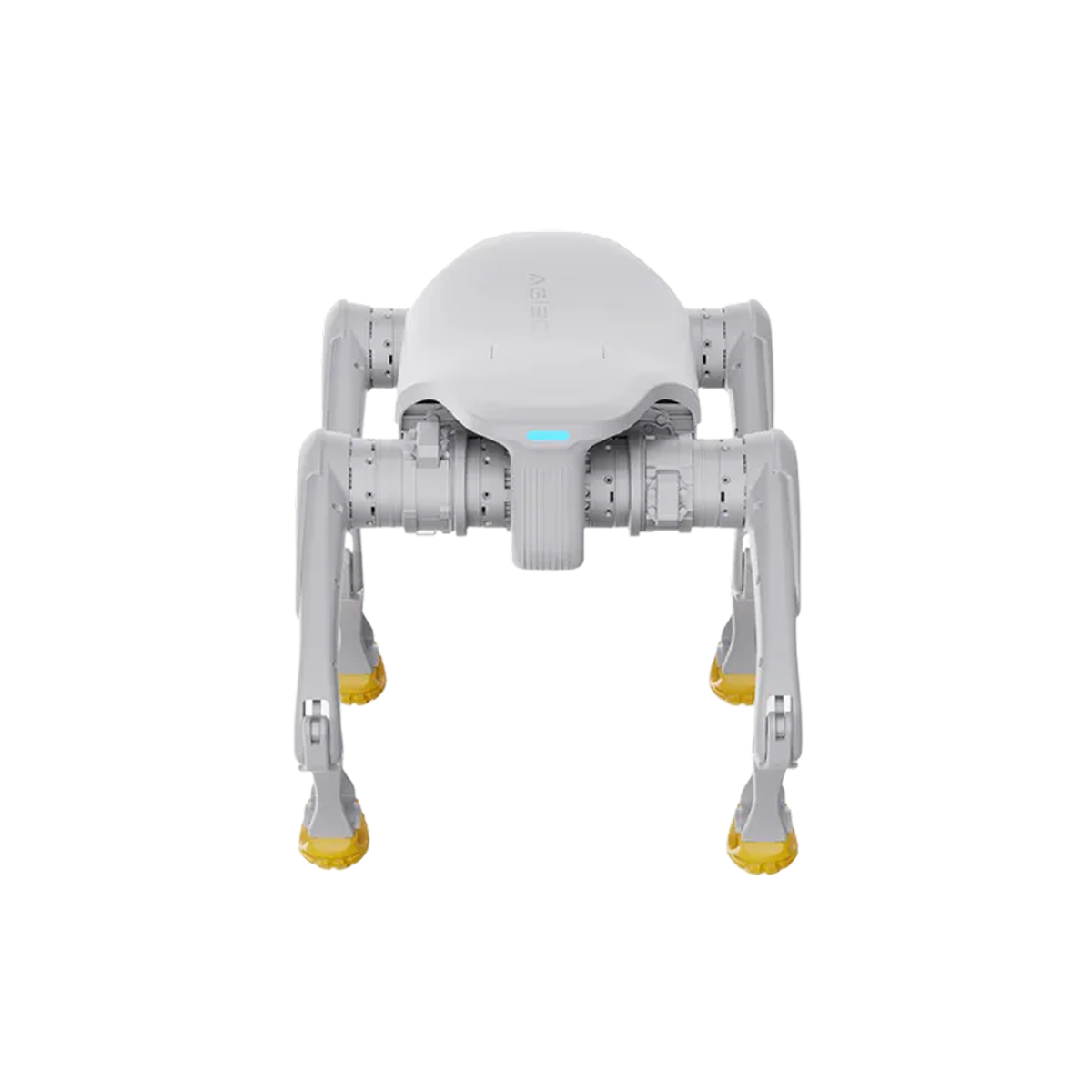
- Built to survive students: anti-collision modules on the front, rear, and thigh joints, plus the yellow anti-slip foot pads you can spot in the photos.
- IP54 rated against dust and splashing water.
- A real teaching program behind it, not just a robot: a 96-hour curriculum developed with a Tsinghua University team, with 200+ video lessons and bilingual materials.
- Edu only: standardized expansion interfaces compatible with LiDAR, RGB-D cameras, and custom mounted payloads.
- Folds down to 145 mm (5.7 in) tall lying, so it transports and stores in a normal case.
AgiBot D1 Pro and D1 Edu Specs
| Spec | Value |
|---|---|
| Standing dimensions (L × W × H) | 635 × 360 × 420 mm (25.0 × 14.2 × 16.5 in) |
| Lying dimensions (L × W × H) | 675 × 435 × 145 mm (26.6 × 17.1 × 5.7 in) |
| Total weight | 15.5 kg (34 lb) including battery |
| Maximum speed | 3.5 m/s (7.8 mph) |
| Vertical jump height | 35 cm (14 in) |
| Effective payload | 5 kg (11 lb) |
| Continuous stair-climbing height | 16 cm (6.3 in) |
| Maximum climbing angle | 30° standard, up to 40° maximum |
| Battery module | 4.6 Ah, 43.2 V |
| Battery life | 1–2 hours |
| Operating temperature | 0°C to 40°C (32°F to 104°F) |
| Ingress protection | IP54 |
| Joint service life | 1,000+ hours, per AgiBot's education configuration |
| External expansion ports | Ethernet, USB, power, SBUS, UART (Edu version only) |
| Secondary development | Edu version only |
| FCC ID | 2BTPT-ZYCXD105U |
US equipment authorization. The D1 Pro and D1 Edu carry FCC ID 2BTPT-ZYCXD105U, granted before the FCC's 28 July 2026 rule change. You can verify it yourself in the FCC's official equipment authorization database at apps.fcc.gov/oetcf/eas. We check every SKU we list against that database before we sell it.
Specifications per the AGIBOT D1 Pro/Edu datasheet and AgiBot product documentation. Subject to change at final delivery.
The Education Toolkit
The reason a school buys the Edu rather than a cheaper quadruped is usually not the robot, it is what comes with it. AgiBot packages a research and education program around the D1 Edu, developed with a team from Tsinghua University, and it is the part that decides whether a department can actually teach a course next semester or spends a year writing one.
- A 96-hour curriculum spanning two semesters, structured from basic to advanced, built around a theoretical foundation, practical application, and case studies rather than a pile of demos.
- Eight categories of bilingual English and Chinese teaching materials covering theory, practice, and application.
- Over 200 video lessons and over 300 exercises, which is what makes it teachable by faculty who are not themselves roboticists.
- An educational upper assembly that adds LiDAR and a depth camera for environmental perception, a voice-capable HMI, and expansion interfaces on a unified power supply.
- A 156 TOPS compute module on the education build, for students running perception and learning workloads on the robot rather than tethered to a workstation.
- Full-stack open precise control with low-level interfaces, which is the part competition teams and graduate researchers actually need and the part the D1 Pro does not give you.
- 1,000+ hours of joint service life on the industrial-grade high-precision joints, quoted by AgiBot for the education configuration.
The curriculum and the educational upper assembly are quoted separately from the robot. Tell us whether you are buying a teaching platform, a research platform, or a competition platform and we will scope the right combination rather than selling you all three.
Built For
- High school and community college robotics programs that need a real quadruped under $5,000
- University labs teaching legged locomotion, reinforcement learning, and mobile robotics (Edu)
- Research groups needing a platform they can mount sensors on and write code against (Edu)
- Competition teams that need low-level control access rather than a fixed behavior set (Edu)
- Marketing teams, trade shows, and live demonstrations
- Entertainment, content production, and public engagement
- Security and facilities teams evaluating quadrupeds before committing to an industrial unit
Good to Know
- Buy the Edu if anyone will write code. The Pro has no expansion ports and no SDK, and it cannot be upgraded into an Edu later.
- The curriculum and the educational upper assembly are separate line items from the robot itself. Ask for them explicitly on your quote rather than assuming they are in the box.
- Operating temperature is 0°C to 40°C (32°F to 104°F). This is not a cold-weather machine.
- IP54 handles dust and splashing water, not immersion or pressure washing. For wet or heavy industrial sites, look at the IP67-rated D1 Max.
- Battery life is 1–2 hours depending on payload and terrain. Order spare batteries for teaching labs where the robot runs all day.
- At 3.5 m/s (7.8 mph) and 35 cm (14 in) of vertical jump, this robot moves fast enough to need clear space and a supervising operator.
How Purchasing Works
Send us the configuration, quantity, and ship-to address and we return a formal written quote, typically the same or next business day. We support purchase orders from school districts, universities, and public agencies, and we accept tax-exempt purchasing with a valid certificate on file. Multi-unit classroom pricing is available.
Frequently Asked Questions
How much does the AgiBot D1 Pro cost?
The D1 Pro is $4,599 and the D1 Edu is $7,199. Multi-unit pricing is available for classroom sets.
Is the AgiBot D1 authorized for use in the US?
Yes. The D1 Pro and D1 Edu carry FCC ID 2BTPT-ZYCXD105U, granted before the FCC's 28 July 2026 rule change. You can verify it directly in the FCC's equipment authorization database at apps.fcc.gov/oetcf/eas. Note that FCC equipment authorization is separate from NDAA procurement eligibility, which is a different question for federally funded buyers.
What is the difference between the D1 Pro and the D1 Edu?
Mechanically they are the same robot. The Edu adds secondary development support and standardized expansion ports (Ethernet, USB, power, SBUS, UART) so you can mount payloads and write your own code. The Pro has neither.
Does it come with a curriculum?
AgiBot offers one, developed with a Tsinghua University team: 96 hours across two semesters, eight categories of bilingual English and Chinese materials, 200+ video lessons and 300+ exercises. It is quoted separately from the robot, so ask for it on your quote and we will confirm scope and pricing before you order.
Can I upgrade a D1 Pro to an Edu later?
No. The expansion interfaces and development support are configured at build. If there is any chance you will need to program the robot, buy the Edu up front.
Can it carry a LiDAR or camera?
Yes, on the Edu version. Effective payload is 5 kg (11 lb) and the expansion interfaces are designed for LiDAR, RGB-D cameras, and other mounted sensors. AgiBot's educational upper assembly bundles LiDAR, a depth camera and a voice HMI if you would rather not source them yourself.
How long does the battery last?
One to two hours depending on payload and terrain. Spare batteries are recommended for teaching labs.
Can it climb stairs?
Yes. Continuous stair-climbing height is 16 cm (6.3 in), with a 30° standard climbing angle and up to 40° maximum.
Is it weatherproof?
It is IP54, which covers dust and splashing water. It is not rated for immersion, pressure washing, or sub-freezing operation. Operating range is 0°C to 40°C (32°F to 104°F).
How does it compare to the D1 Ultra?
The D1 Ultra is a slightly heavier 16 kg (35 lb) unit with a higher 3.7 m/s (8.3 mph) top speed and about 4.7 km (2.9 mi) of range in its configured patrol build, at $7,999. The Pro and Edu are the lower-cost entry into the D1 family. All three share the same 5 kg (11 lb) payload and IP54 rating.
Do you accept purchase orders?
Yes. We work with school districts, universities, and public agencies regularly and accept POs and tax-exempt purchasing.
Is there US warranty support?
Yes. Units are sourced through AgiBot's authorized US distribution and carry US-based warranty and repair.
Warranty & U.S. Support
Every AgiBot unit we sell is sourced through AgiBot's authorized US distribution and carries US-based warranty and repair coverage. Global Drone HQ provides pre-sale configuration help and post-sale support directly, and we handle warranty coordination on your behalf. Purchase orders and tax-exempt purchasing are welcome for schools, universities, and public agencies.
Explore the AgiBot Lineup
Browse the full AgiBot robot collection, or compare with the D1 Ultra for patrol work, the D1 Max for industrial payloads, and the X2 humanoid for interactive deployments.
Verified US equipment authorization, FCC ID 2BTPT-ZYCXD105U
Sourced through AgiBot's US master distributor
Freight quoted to your destination
Purchase orders and tax-exempt purchasing welcome

Max speed

Vertical jump

Weight with battery

Expansion ports and API

US equipment authorization
Pairs well with
Questions about configuration, lead time or deployment? We reply within one business day.
-
Shipping and Delivery
Robots ship freight and insured to your dock or venue. Freight is quoted to your destination address and appears as a line item on your written quote. Lead time is confirmed in writing before you commit to a delivery date.
-
Support
You deal with Global Drone HQ directly, before and after the sale. We help you pick the right configuration, handle delivery and deployment, first-line troubleshooting and periodic inspection, and we coordinate anything that needs the factory rather than handing you an address overseas.
-
Warranty and Service
AgiBot is responsible for complete-machine warranty service, including repair or replacement of core components, software debugging and upgrades, and complex repairs that cannot be resolved through remote guidance. Global Drone HQ handles deployment, routine troubleshooting and on-site support. Units are sourced through AgiBot's US master distributor.
-
Contact Us
Email daniel@globaldronehq.com or call (858) 906-5185. Purchase orders and tax-exempt purchasing are welcome for schools, universities and public agencies.

Balance, agility and a chassis built to survive students.
The same reinforcement-learning motion control as the rest of the D1 family, on a 15.5 kg (34 lb) platform with anti-collision modules and anti-slip footpads. The Edu adds the SDK and expansion ports for anyone who will write code against it.
From $4,599 • 96-Hour Curriculum • SDK on Edu • FCC Verified • Classroom Pricing
Dig Deeper
Pro vs Edu, the Decisive Difference
- Mechanically identical. Both are 15.5 kg (34 lb), 3.5 m/s (7.8 mph), 5 kg (11 lb) payload, 35 cm (14 in) vertical jump, IP54.
- D1 Edu adds secondary development with an SDK and standardized expansion ports: Ethernet, USB, power, SBUS and UART.
- D1 Pro has neither, and cannot be upgraded into an Edu later. The interfaces are configured at build.
- Buy the Edu if anyone will write code. Buy the Pro if you want a demonstration robot that works out of the box and saves $2,600.
The Education Toolkit
- A 96-hour curriculum spanning two semesters, developed with a team from Tsinghua University, structured from basic to advanced.
- Eight categories of bilingual English and Chinese materials covering theory, practice and application.
- Over 200 video lessons and over 300 exercises, teachable by faculty who are not themselves roboticists.
- An educational upper assembly adding LiDAR, a depth camera and a voice-capable HMI on a unified power supply.
- A 156 TOPS compute module on the education build, plus full-stack open low-level control interfaces for competition and research teams.
- Quoted separately from the robot. Ask for them explicitly rather than assuming they are in the box.
Specs and Durability
- 15.5 kg (34 lb) including battery, 635 × 360 × 420 mm (25.0 × 14.2 × 16.5 in) standing, folding to 145 mm (5.7 in) tall.
- 3.5 m/s (7.8 mph) top speed and a 35 cm (14 in) vertical jump from a 2 kW/kg joint system.
- 16 cm (6.3 in) continuous stair climbing, 30° standard climbing angle, up to 40° maximum.
- Built to survive students: anti-collision modules on front, rear and thigh joints, plus yellow anti-slip foot pads.
- 1,000+ hours of joint service life quoted by AgiBot for the education configuration.
- IP54 and 0°C to 40°C (32°F to 104°F). Battery life is one to two hours, so order spares for labs that run all day.
Compare the D1 Lineup
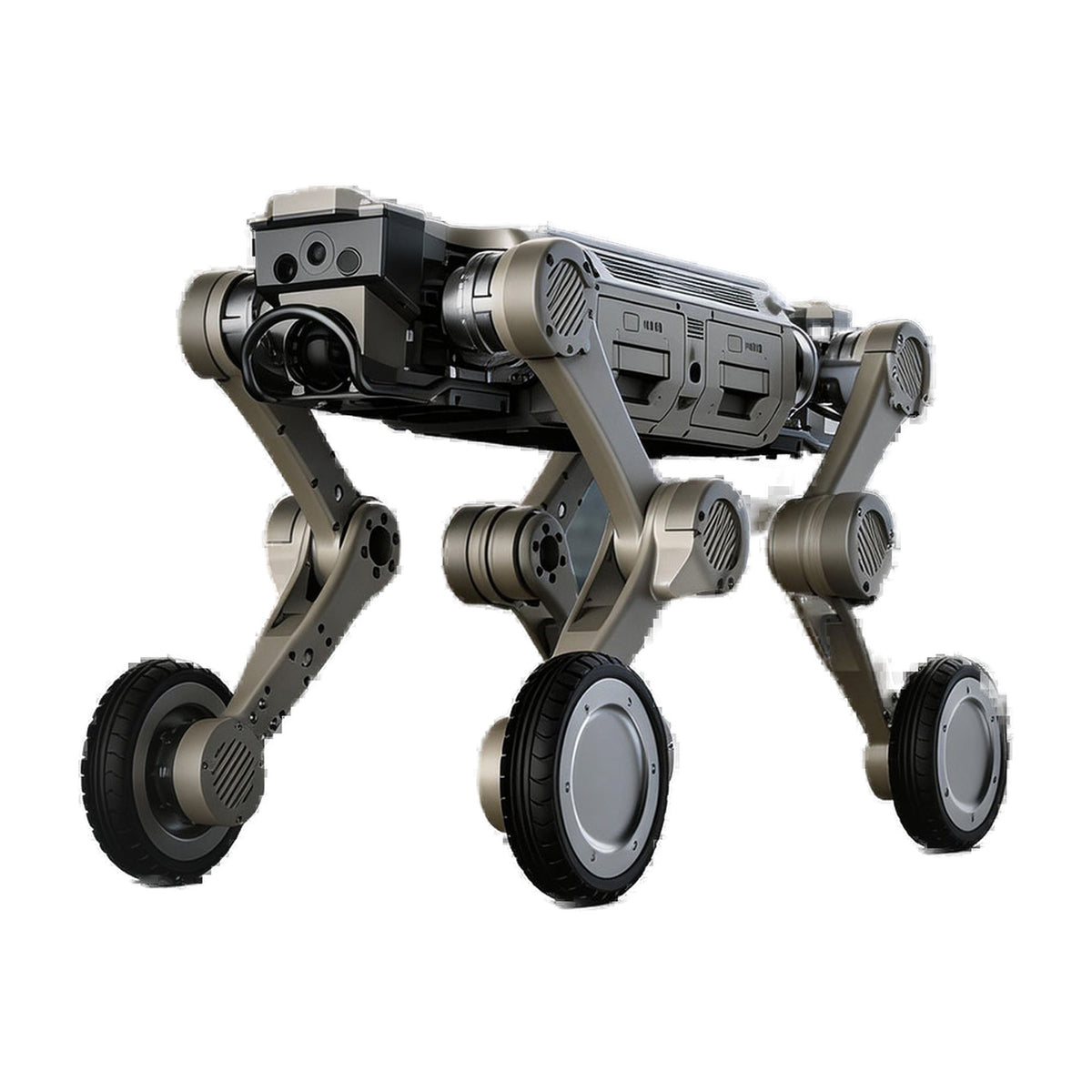
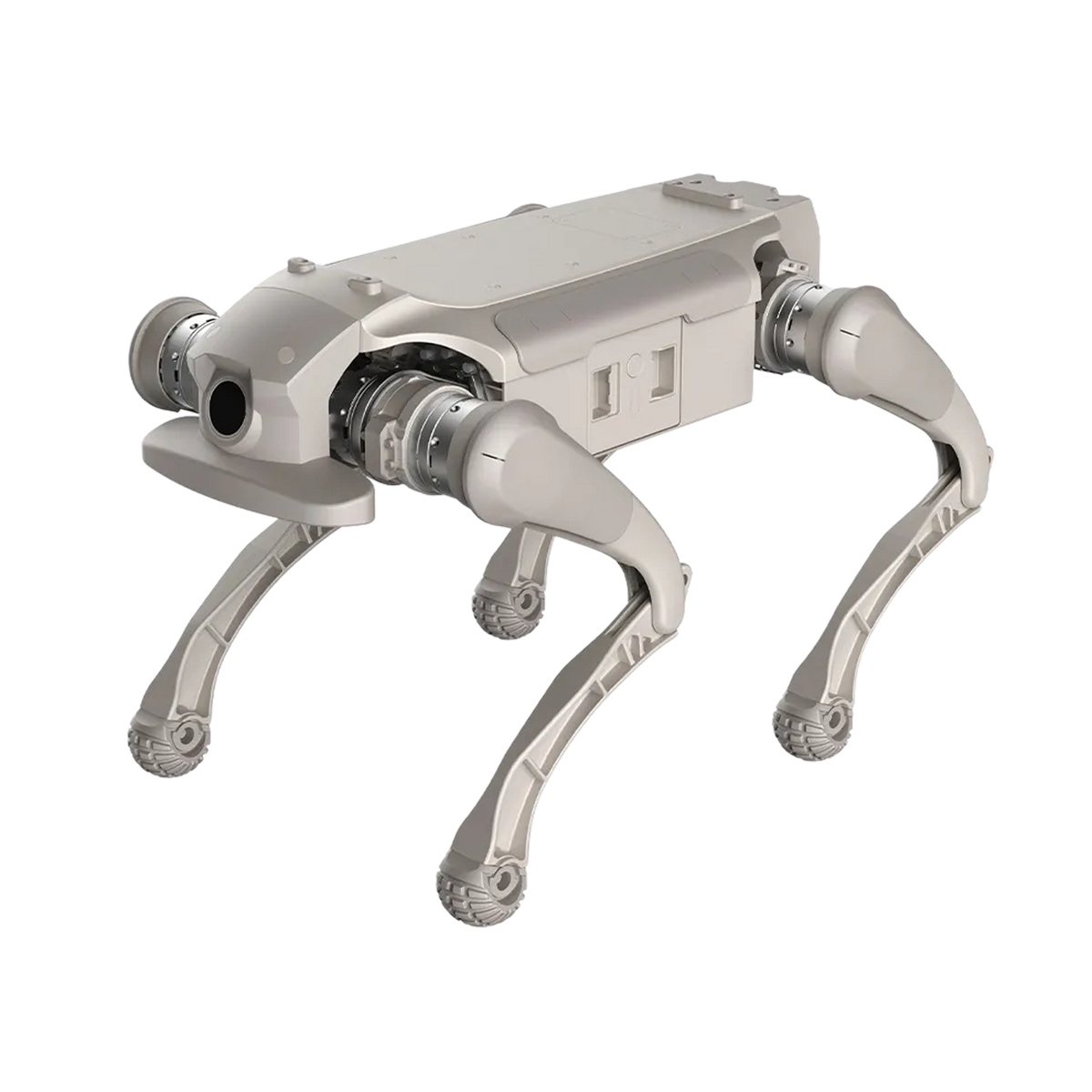
Three very different machines that share a name. Protection rating and endurance are quoted for the configured build, not the bare chassis.
Weight
41 kg (90 lb)
Weight
16 kg (35 lb)
Weight
15.5 kg (34 lb)
Top Speed
6 m/s (13.4 mph) max wheel speed
Top Speed
3.7 m/s (8.3 mph)
Top Speed
3.5 m/s (7.8 mph)
Rated Payload
25 kg (55 lb) rated
Rated Payload
5 kg (11 lb)
Rated Payload
5 kg (11 lb)
Protection
IP67 bare / IP66 inspection / IP55 patrol
Protection
IP54
Protection
IP54
Endurance
3.5 h at rated load
Endurance
1–2 h bare, ~45 min patrol
Endurance
1–2 h
Locomotion
Wheel and leg modes
Locomotion
Legged
Locomotion
Legged
Operating Temp
-20°C to 55°C (-4°F to 131°F)
Operating Temp
0°C to 40°C (32°F to 104°F)
Operating Temp
0°C to 40°C (32°F to 104°F)
Best For
Industrial inspection and patrol
Best For
Patrol, disaster response, research
Best For
Education, demos, events
Price
$42,999
Price
$7,999
Price
From $4,599
FAQs
What is the difference between the D1 Pro and the D1 Edu?
Mechanically they are the same robot. The Edu adds secondary development support and standardized expansion ports so you can mount payloads and write your own code. The Pro has neither.
Can I upgrade a D1 Pro to an Edu later?
No. Expansion interfaces and development support are configured at build. If there is any chance you will need to program the robot, buy the Edu up front.
Does it come with a curriculum?
AgiBot offers one, developed with a Tsinghua University team: 96 hours across two semesters, eight categories of bilingual materials, over 200 video lessons and over 300 exercises. It is quoted separately from the robot.
Is the D1 authorized for use in the US?
Yes. The D1 Pro and D1 Edu carry FCC ID 2BTPT-ZYCXD105U, granted before the FCC's 28 July 2026 rule change, verifiable at apps.fcc.gov/oetcf/eas.
Can it carry a LiDAR or camera?
Yes, on the Edu version. Effective payload is 5 kg (11 lb). AgiBot's educational upper assembly bundles LiDAR, a depth camera and a voice HMI if you would rather not source them yourself.
Do you accept purchase orders?
Yes. We work with school districts, universities and public agencies regularly and accept POs and tax-exempt purchasing. Multi-unit classroom pricing is available.