

Quick Decision Guide
- Thermal inspection, public safety daytime ops, or mapping: EVO Max 4T XE -- $8,999
- Night operations, low-light surveillance, or darkness SAR: EVO Max 4N -- $12,599
- Budget is the primary constraint: Step down to the EVO II V3 series from $2,099
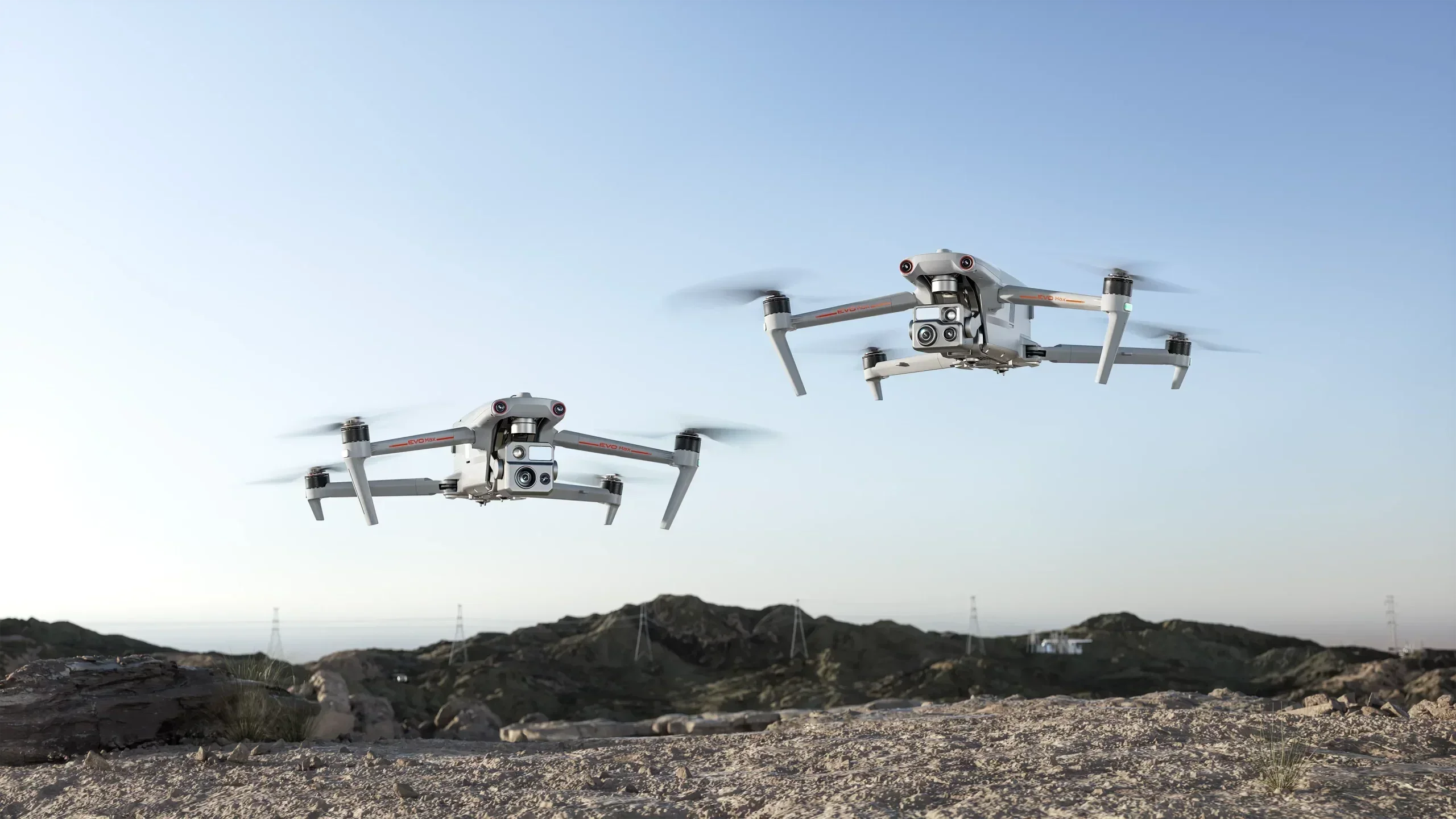
The Autel EVO Max is the flagship enterprise multirotor in the EVO lineup. Two distinct models define the platform: the EVO Max 4T XE, built around a multi-sensor daytime and thermal payload, and the EVO Max 4N, engineered specifically for operations in complete darkness. Both share the same aircraft, transmission system, and accessories ecosystem -- but the sensor payloads serve fundamentally different mission profiles.
For context on where the EVO Max fits within the full Autel product range, see the Autel EVO Series Complete Guide.
Why EVO Max Over DJI Matrice 30T or Matrice 4T?
The EVO Max competes against the DJI Matrice 30T and the newer Matrice 4T. Here is where it has concrete advantages:
- 20km transmission range vs 15km on the M30T and M4T. For large-area surveillance, BVLOS operations, or wide-area SAR, range matters.
- A-Mesh networking. Multiple EVO Max units can relay signals through each other, extending effective range and coverage for multi-aircraft deployments. DJI does not offer peer-to-peer mesh networking at this price tier.
- GPS-denied SLAM navigation. The EVO Max can maintain stable autonomous flight in environments where GPS is unavailable or unreliable -- indoor structures, urban canyons, industrial facilities. The M30T and M4T require GPS for autonomous flight.
- Interchangeable gimbals. The 4T XE and 4N payloads are swappable on the same aircraft body. One aircraft, two mission profiles.
- No geofencing. Launch authority stays with the operator.
DJI has advantages in software maturity and global support infrastructure. The EVO Max is the correct choice when range, mesh networking, SLAM capability, or geofencing freedom are mission requirements.
EVO Max 4T XE -- $8,999
The EVO Max 4T XE carries a multi-sensor payload that combines four distinct imaging systems in a single gimbal: a 48MP zoom camera with 10x optical / 160x digital zoom, a 50MP wide-angle camera, a 640x512 thermal camera, and a 1.2km laser rangefinder. This combination covers the majority of enterprise mission requirements -- thermal inspection, optical zoom surveillance, wide-area mapping, and distance-to-target calculation -- in a single flight.
4T XE Key Specs
- Zoom camera: 48MP, 10x optical zoom, up to 160x digital zoom
- Wide camera: 50MP
- Thermal camera: 640x512 resolution
- Laser rangefinder: up to 1.2km
- Transmission range: 20km
- Flight time: up to 42 minutes
- Wind resistance: Level 12
- Navigation: GPS/GLONASS/BeiDou + SLAM
Who the 4T XE Is For
The 4T XE is the workhorse choice for public safety agencies, utility inspection teams, and mapping crews that need thermal capability alongside optical zoom. The 10x optical zoom allows identification at standoff distances where a suspect, person in distress, or infrastructure defect can be confirmed without overflying. The thermal layer provides heat signature detection across the same scene. The laser rangefinder calculates distance and coordinates for tactical or inspection use.
EVO Max 4N -- $12,599
The EVO Max 4N is built around a single mission: visibility in complete darkness. The Starlight camera achieves ISO 450,000 sensitivity, allowing the 4N to produce usable color video in conditions where most drones see nothing. Moonlight Algorithm 2.0 processes the sensor output to reduce noise and enhance detail in extremely low-light environments. The result is a platform designed for nighttime law enforcement surveillance, SAR in unlit terrain, and security applications where lighting the scene with a spotlight is tactically unacceptable.
4N Key Specs
- Starlight camera: ISO 450,000 max sensitivity
- Algorithm: Moonlight Algorithm 2.0 for low-light noise reduction
- Transmission range: 20km
- Flight time: up to 42 minutes
- Wind resistance: Level 12
- Navigation: GPS/GLONASS/BeiDou + SLAM
Who the 4N Is For
The 4N has one use case where it is definitively the superior tool: operating in total or near-total darkness at distance, without revealing the drone's position through active lighting. For nighttime law enforcement surveillance, rural SAR in unlit environments, and security overwatch where covert presence matters, the 4N's Starlight sensor delivers capability that no other drone at this price provides. The $3,600 premium over the 4T XE is justified only if nighttime operations are a primary mission profile -- not occasional.
EVO Max 4T XE vs 4N: Head-to-Head
| Spec | EVO Max 4T XE | EVO Max 4N |
|---|---|---|
| Price | $8,999 | $12,599 |
| Primary sensor | 48MP zoom + 50MP wide + 640x512 thermal | Starlight ISO 450,000 |
| Thermal camera | Yes -- 640x512 | No |
| Optical zoom | 10x optical / 160x digital | Optical zoom (model-specific) |
| Laser rangefinder | Yes -- up to 1.2km | Yes |
| Night ops | Limited -- thermal sees heat, not color | Exceptional -- ISO 450,000 color video |
| Best missions | Thermal inspection, public safety, mapping | Nighttime surveillance, covert SAR, LE |
| Flight time | Up to 42 min | Up to 42 min |
For a deeper comparison, see the EVO Max 4T XE vs 4N full comparison guide.
EVO Max Accessories Ecosystem
The EVO Max platform is designed from the ground up for mission customization. Every accessory below is engineered for the EVO Max aircraft -- no third-party compatibility workarounds required. For a complete breakdown of the full accessories lineup, see the EVO Max Accessories Guide.
Flight Operations
- EVO Max Intelligent Flight Battery -- $319: The standard power system for both 4T XE and 4N. A second battery doubles your field session without returning to base.
- EVO Max Multi-Charger -- $145: Charges multiple batteries sequentially. Essential for multi-shift deployments or sustained operations.
- EVO MAX Propellers -- $19: OEM replacement props. Keep a spare set for any field deployment.
- EVO Max Backpack -- $169: Purpose-built carry solution for the EVO Max aircraft and accessories.
Mission Payloads and Tools
- EVO Max RTK Module -- $529: Adds centimeter-accurate positioning for survey and precision mapping missions. Compatible with both 4T XE and 4N aircraft.
- EVO Max Speaker and Spotlight Bundle -- $979: Adds a broadcast loudspeaker and directional spotlight to the EVO Max for public safety, crowd management, and SAR operations.
- EVO Max Payload Drop System-H -- $399: Mechanical payload release system for SAR supply drops, AED delivery, or water rescue line deployment.
Extended Operations
- Autel EVO Nest -- $20,362: The EVO Max autonomous drone dock. The EVO Nest provides weatherproof housing, automatic battery charging, and remote deployment capability -- enabling fully autonomous BVLOS operations without a local pilot. The foundation of a persistent drone-in-a-box security or infrastructure monitoring program.
- FlyPro PRCS Rapid Charging System -- $1,345: Simultaneously charges up to four EVO Max batteries, dramatically reducing turnaround time between sorties for high-tempo field operations. For rapid charging off vehicle power in the field, see our Autel field charging guide.
- Volarious V-Line Pro Tether Kit -- $13,999: A tethered power system that provides indefinite hover time for the EVO Max via a 70m power cable. Eliminates battery swap cycles for persistent overwatch, perimeter security, or extended communications relay missions.
Frequently Asked Questions
What is the EVO Max wind resistance rating?
Both the EVO Max 4T XE and EVO Max 4N are rated Level 12 wind resistance. This is the highest wind resistance rating among consumer and commercial drones in the EVO lineup, enabling deployment in conditions that ground most competing platforms.
Does the EVO Max work without GPS?
Yes. The EVO Max includes SLAM (Simultaneous Localization and Mapping) navigation that allows stable autonomous flight in GPS-denied environments including indoor spaces, tunnels, and urban canyons with dense signal obstruction.
Can I swap the payload between the 4T XE and 4N?
Yes. The EVO Max uses an interchangeable gimbal system. The 4T XE and 4N payloads can be swapped on the same aircraft body, allowing one drone to serve both thermal/mapping missions (with the 4T XE payload) and nighttime operations (with the 4N Starlight payload).
What is A-Mesh networking?
A-Mesh is Autel's peer-to-peer mesh network protocol that allows multiple EVO Max drones to relay signals through each other. In a multi-aircraft deployment, each drone acts as both an operator-controlled unit and a signal relay, extending the effective range of the entire fleet beyond what any single aircraft could achieve independently.
See Also
- Autel EVO Series: Complete Guide 2026 (Lite vs II vs Max)
- Autel EVO Max 4T XE vs 4N: Which Is Best for Your Mission?
- Autel EVO Max Accessories and Payloads Guide 2026
- Autel EVO II V3 Series: Complete Buyer's Guide 2026
- Autel Alpha Buyer's Guide
- Drone Protection Plans: Crash and Accidental Damage Coverage
Share:
DJI Zenmuse L2: A Comprehensive Buyer's Guide
ABZ Innovation L30 vs. DJI Agras T50: Which Agricultural Drone Reigns Supreme?