

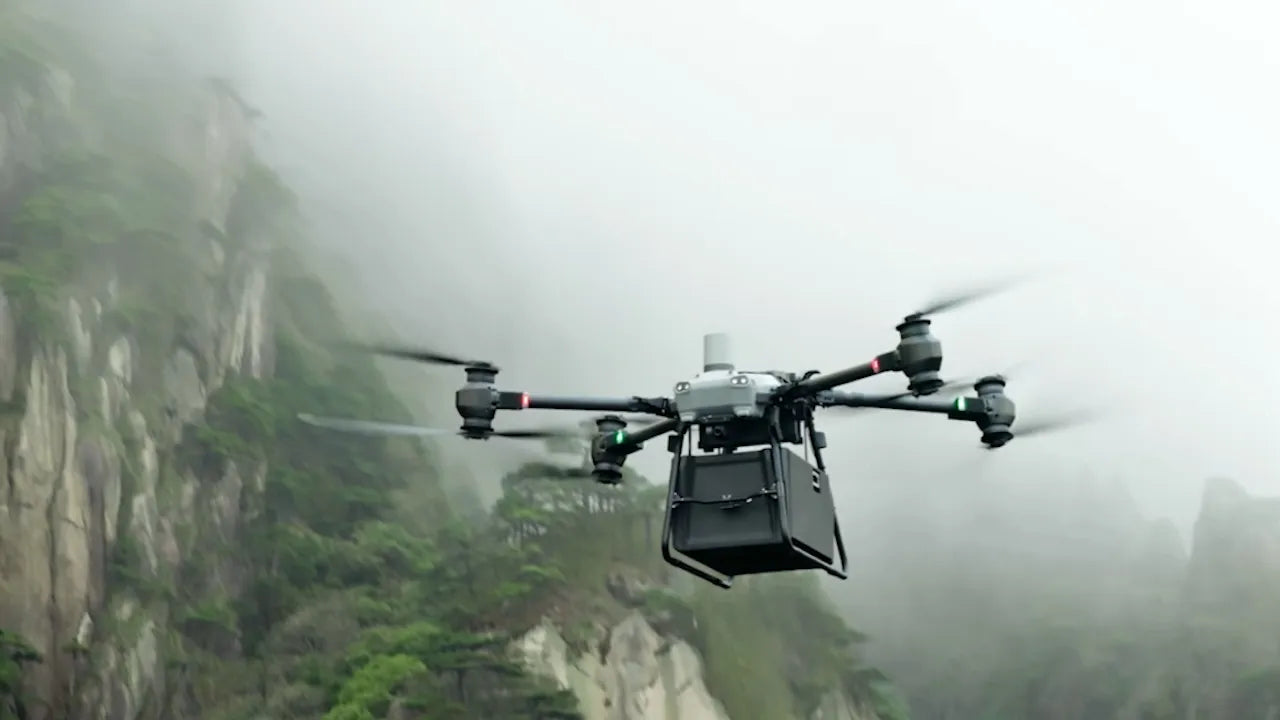
Heavy-payload drones, also known as heavy-lift UAVs, are a new class of robust aerial vehicles capable of carrying tens to hundreds of kilograms. They are transforming industries by handling tasks once reserved for traditional cranes or helicopters, making jobs faster, safer, and more cost-effective.
This guide will explore the top use cases for heavy-lift drones in both the construction and film industries, and provide a look at the technology, models, and challenges involved.
Heavy-Lift Drones in Construction
In construction, heavy-lift drones are changing how teams manage logistics, transport materials, safety, and inspections on site. These drones are used for material delivery in both urban and rural areas, highlighting their versatility across diverse construction environments.
Material Delivery to Remote or Difficult Sites
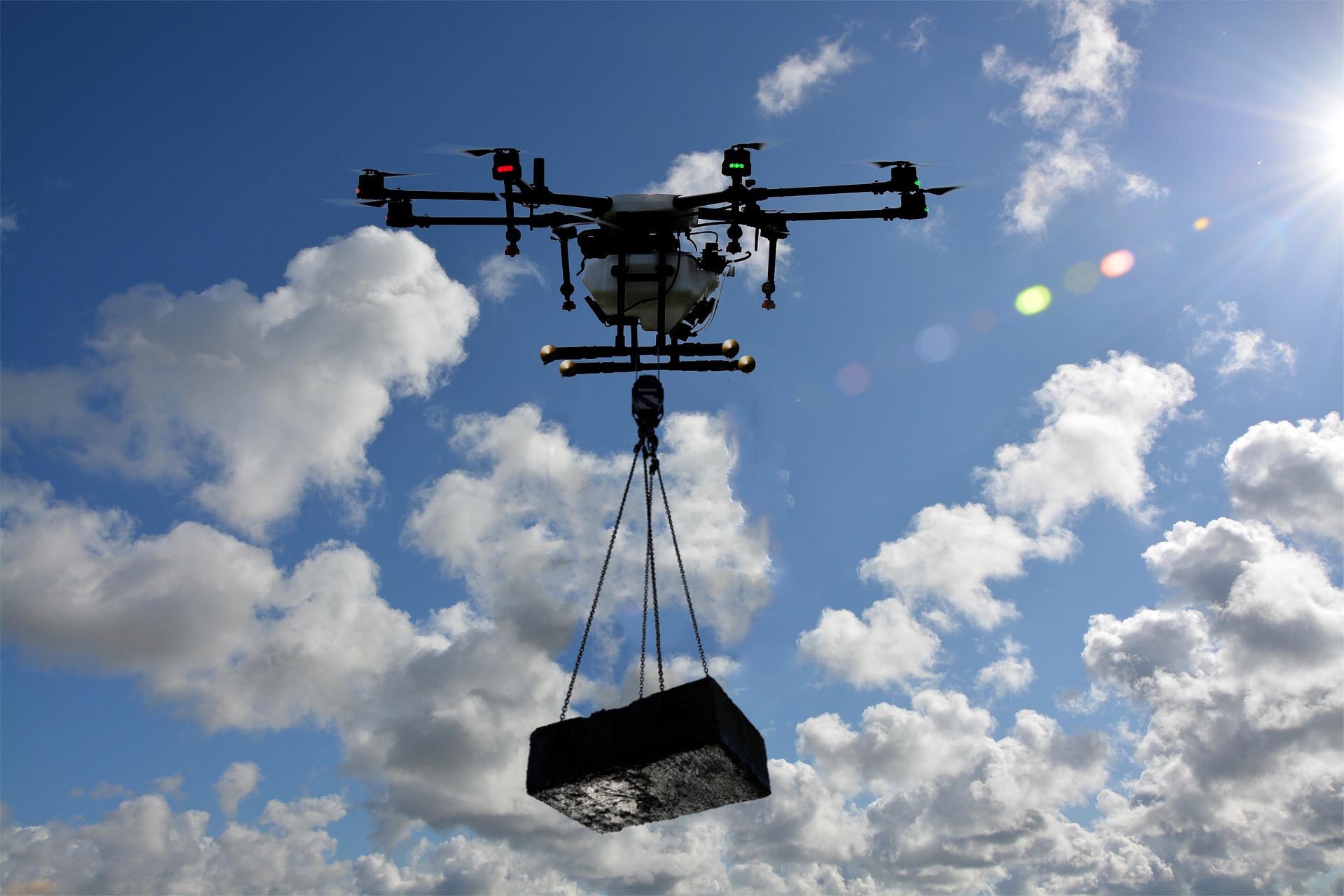
One of the most impactful uses is transporting materials to hard-to-reach locations. Heavy drones can function as "flying cranes" to deliver tools, parts, and even building materials to high-altitude sites or areas with rugged terrain, a task that would otherwise require helicopters or dangerous manual labor. For instance, a heavy UAS in Canada successfully slung over 1,800 lbs of powerline equipment across wetlands, avoiding environmental damage and reducing setup time.
Aerial Lifting and Assembly Operations
Beyond transport, heavy-lift drones are assisting with assembly. They can be used to hoist powerline components into position, allowing crews to work safely on the ground. Research is even exploring how drones can cooperate to lift and place heavy objects for modular construction, hinting at a future where drones assist in building structures.
Surveying with Advanced Sensors
While smaller drones are used for basic site surveys, aerial surveying is a key application for heavy-lift drones due to their ability to support more advanced tasks. Heavy-lift drones can carry more advanced sensors, such as high-resolution LiDAR units or multi-sensor arrays, and can transport multiple payloads simultaneously for comprehensive data collection. This allows them to create rich 3D point clouds of large construction sites or inspect bridges with multiple instruments in a single, stable flight, accelerating infrastructure inspections and improving data quality.
Improving Safety and Efficiency on Site
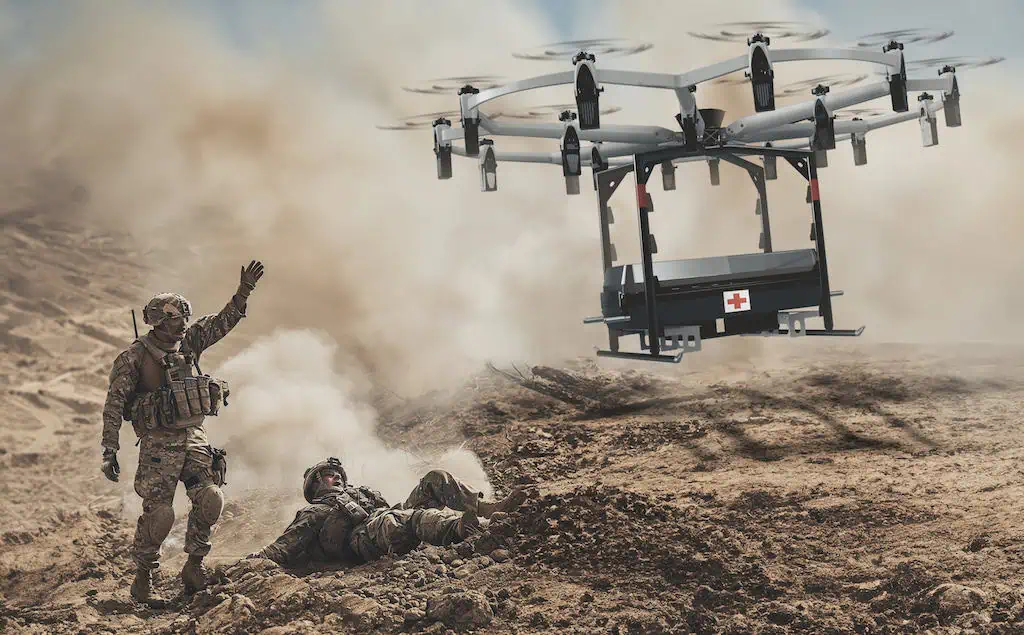
Safety is a major selling point for drone use. By using drones to handle dangerous tasks like lifting heavy materials or inspecting unstable structures, construction firms can keep workers out of harm’s way. Drones also reduce the need for workers to operate heavy machinery in hazardous conditions, which in turn helps cut down on site accidents.
Components of Heavy-Lift Drones
Heavy-lift drones are sophisticated machines engineered to transport substantial payloads across a variety of demanding environments. Their ability to perform heavy lift operations safely and efficiently depends on a combination of advanced components, each designed to maximize performance and reliability. Understanding these key elements is crucial for anyone considering lift drones for industrial applications, whether for construction, delivery, or emergency response.
Motors and Propellers
At the heart of every heavy lift drone are its motors and propellers, which work together to generate the powerful thrust needed to carry heavy payloads. These drones are equipped with high-torque brushless motors and oversized, aerodynamically optimized propellers. This combination ensures that the drone can achieve the necessary lift while maintaining energy efficiency, which is vital for maximizing flight time and operational range. For example, the Freefly Alta X, one of the top heavy-lift drones on the market, utilizes robust motors and precision-engineered propellers to support a maximum payload capacity of 35 lbs (15.9 kg). This makes it a preferred choice for carrying advanced sensors and heavy camera equipment in industrial applications, where stable flights and reliable heavy lift performance are essential.
Gimbal and Payload Systems
The gimbal and payload systems are what allow heavy-lift drones to safely transport and stabilize their cargo, whether it’s sensitive electronics, medical supplies, or construction materials. Gimbals are especially important for missions that require carrying advanced sensors or high-end cameras, as they provide smooth, stable footage and accurate data collection even in challenging flight conditions. Payload systems can be highly specialized, ranging from secure hooks and cargo bays to winch systems for precise delivery. The DJI FlyCart 30, for instance, features a versatile winch system that enables it to lower payloads safely to the ground, making it ideal for urban air mobility, medical supply delivery, and search and rescue missions. In agriculture, similar systems are used for precision spraying, while in emergency response, they ensure critical supplies reach their destination quickly and safely.
Navigation and Control Systems
Navigation and control systems are the brains behind heavy-lift drones, ensuring safe, accurate, and efficient operations. These systems typically include GPS modules, accelerometers, gyroscopes, and sometimes advanced sensors like lidar for obstacle detection and avoidance. Many large commercial drones offer dual operator mode, allowing one person to pilot the drone while another manages the payload, which is especially useful for complex missions in disaster relief or large-scale construction projects. Advanced navigation technology enables precise landing, extended flight times, and the ability to remain airborne over vast areas, even in challenging environments. The Griff Aviation 300, known for its modular design and impressive payload capacity, leverages sophisticated navigation and control systems to support large scale operations, from transporting materials on construction sites to delivering aid in disaster zones. These features ensure that heavy lift drones can perform reliably and safely, even when operating in the most demanding conditions.
Heavy-Lift Drones in Film Production
Heavy-lift drones have opened up a new world of creative possibilities for filmmakers, capturing shots that were once impossible or prohibitively expensive. Thanks to advancements in drone technology, filmmakers can now use large drones and big drones to carry heavy cinema equipment, enabling complex aerial cinematography that was previously out of reach.
Carrying Cinema Cameras for Aerial Shots
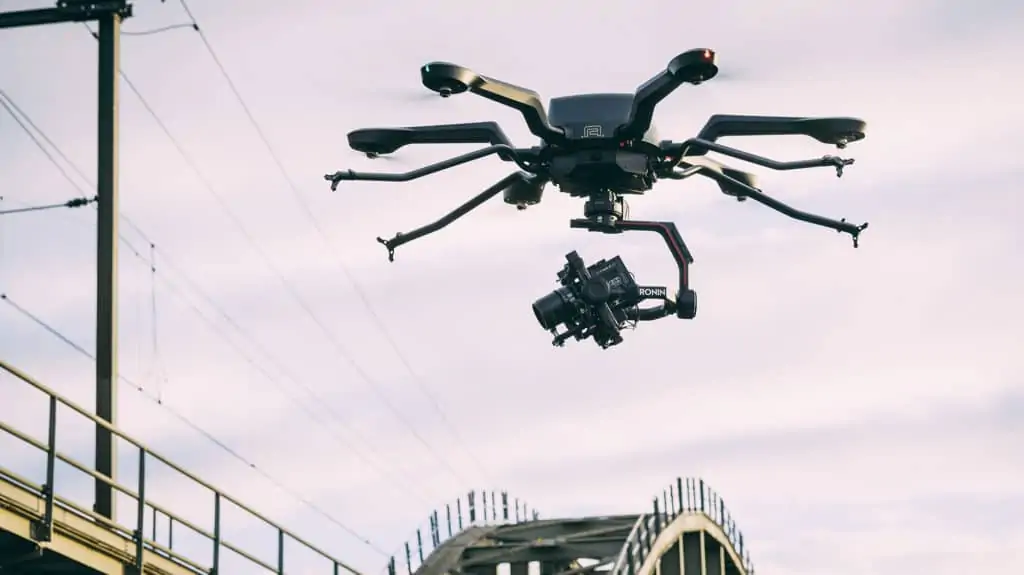
Drones like the Freefly Alta X and specialized custom rigs can carry professional digital cinema cameras (such as ARRI Alexas or REDs), along with heavy gimbals and lenses. This allows cinematographers to achieve Hollywood-quality aerial shots with the same high-end cameras used on the ground, delivering superior image quality for major films.
Drones vs. Helicopters for Filming
Drones offer a more cost-effective and safer alternative to helicopters for many aerial shots. They can operate at lower altitudes, fly through tight spaces, and get closer to actors, creating dynamic and immersive shots. Best of all, a drone doesn't put a pilot or a camera operator at risk.
Flying Lights and Rigging Equipment
An emerging use case is using heavy drones as flying platforms for lighting equipment. These "Drone Lights" can lift powerful LED panels to serve as a backlight or spotlight from unique angles, enabling filmmakers to light night shoots or create dramatic effects without the need for large, expensive cranes.
Key Heavy-Lift Drone Platforms
Several drones stand out for their capabilities in construction and filmmaking. Delivery heavy lift drones are increasingly used in modern delivery systems, including drone delivery for logistics, medical supplies, and last-mile transport. These unmanned aerial vehicles and industrial drones are engineered for professional and industrial use cases, with a wide range of sizes and capabilities—from the largest drone and giant drones capable of carrying people or substantial cargo, to the biggest drone platforms used in military and commercial sectors. Many of these are heavy lifting drones, designed to maximize drone carry capacity and demonstrate how much weight they can transport.
-
DJI FlyCart 30: A new delivery drone with a 30 kg payload capacity, designed for logistics and material transport on construction sites. It features both cargo mode and winch mode, enabling flexible payload delivery—cargo mode ensures stable transport, while winch mode allows precise, automatic drops when landing is impractical. Dual batteries provide extended flight time and enhanced reliability, making it ideal for demanding delivery systems.
-
Autel Titan: A heavy drone with a 10 kg payload and long flight time, ideal for industrial inspection and mapping. It can be equipped with specialized sensors for advanced mapping and inspection tasks.
-
Freefly Alta X: A popular hexacopter with a 16 kg payload capacity, widely used in professional cinematography for carrying heavy camera rigs.
-
JOUAV CW-80: A fixed-wing VTOL drone with an 8-hour flight time and a 50 kg payload, used for long-range mapping and cargo. It supports specialized sensors for mapping and inspection, and its max flight altitude makes it suitable for high-elevation operations.
These platforms represent the largest drones and heavy lifting drones available, with impressive drone carry capabilities and delivery systems tailored for various applications. Understanding how much weight each drone can transport is crucial for matching the right platform to the job. Proper flight planning is essential for operating these large unmanned aerial vehicles safely and efficiently, ensuring mission success and regulatory compliance.
Challenges and Future Outlook
Despite their transformative potential, heavy-lift drones face challenges. They are limited by battery life, which often restricts flight time to 20–40 minutes, and face strict regulations for flights over 55 lbs.
However, the future is promising. We can expect to see advancements in:
-
Hybrid Technology: The rise of gas-electric and hydrogen fuel cell drones will solve the battery life problem, enabling longer flight times and heavier payloads.
-
Autonomy: Drones will become even smarter, with AI-powered systems that can handle complex flight paths and coordinate with other drones to complete a mission. Autonomous flight, enabled by artificial intelligence, will ensure safe, reliable, and efficient drone operations, reducing human error and increasing operational efficiency.
-
Evolving Regulations: As the technology matures and safety is proven, regulations will catch up, allowing for broader commercial use of heavy-lift drones. Passenger drones are also on the horizon, with the potential to revolutionize urban air mobility and human transportation.
Expanding applications for heavy-lift drones include military applications, where military drones are used for surveillance and strategic missions, as well as critical roles in emergency services for disaster relief and rapid delivery of essential supplies. Heavy-lift drones are increasingly being used for agricultural spraying, industrial inspections of infrastructure such as wind turbines, and other sectors requiring high payload capacity and advanced sensors.
Technological advancements are bringing new features like real-time cargo status monitoring and cruise control for stable, long-distance flights. While consumer drones are popular for recreational flying and photography, big drones and large drones are designed for demanding industrial and commercial applications, offering greater payload capacity and specialized capabilities.
The team at Global Drone HQ is here to answer any questions you may have about your drone setup. We can help guide your business or agency through the process of selecting the right heavy-lift drone and a robust, secure solution that meets your specific mission requirements.
Share:
How Heavy Lift Drones Are Transforming Industrial Logistics
OGI Cameras (Optical Gas Imaging): The Ultimate Guide to Gas Leak Detection Technology