
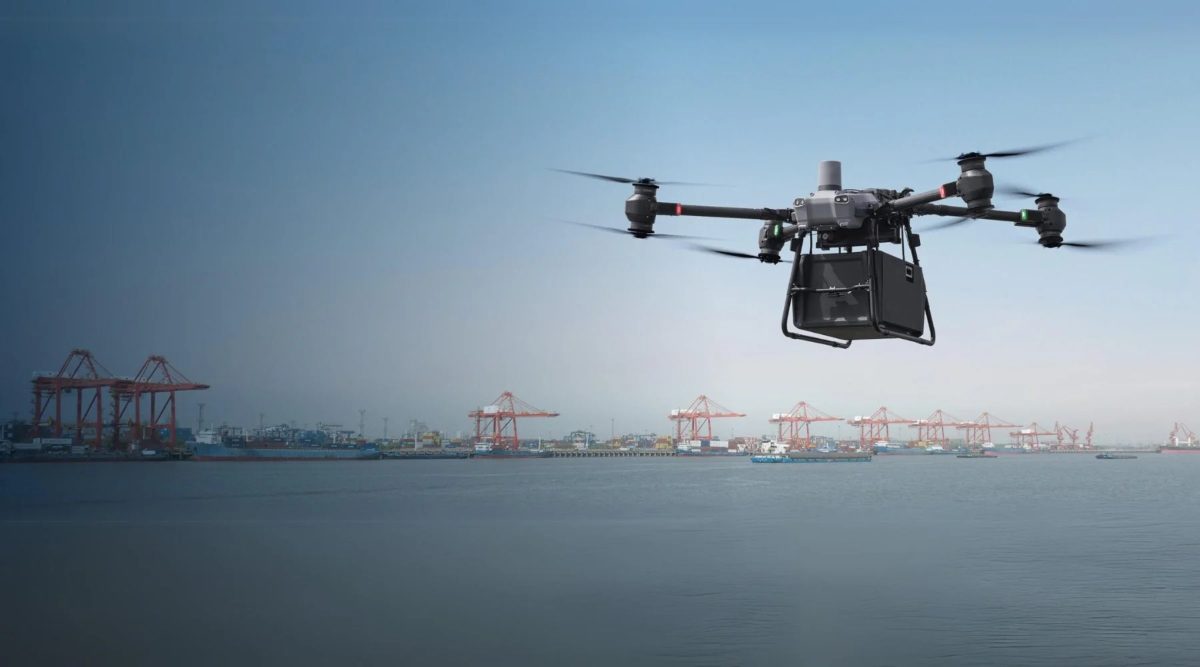
Most people searching for "heavy lift drone" are actually looking for one of two things: a way to spray or seed hundreds of acres faster than ground equipment allows, or a way to move cargo where vehicles can't go. These are very different problems, and the platforms that solve them look nothing alike.
This guide is organized around what you actually need. We carry the DJI Agras T100 and it's the best agricultural heavy-lift drone available today — so we'll give it the space it deserves. We'll also cover the logistics and cinema platforms that round out the category, and what you actually need to know before spending $20,000–$40,000 on any of them.
DJI Agras T100: The Best Heavy-Lift Drone for Agriculture
The T100 is a purpose-built agricultural spraying and spreading drone. Its payload isn't something strapped to a hook — it's loaded directly into a 100L onboard tank. At max capacity, that's 100 kg (220 lbs) of liquid: herbicide, fungicide, fertilizer, whatever you're applying. That's the largest tank of any production ag drone on the market. For spreading operations (seed, granular fertilizer, etc.), the spreading system handles up to 100 kg as well.
To put the scale in perspective: a DJI Agras T40 carries 40L. The T100 carries 2.5× that per flight. At 70+ acres per hour of operational efficiency, a single T100 can cover ground that would take a small fleet of older ag drones or a full day of tractor work.
- Spray payload: 100 kg (220 lbs) — 100L tank capacity
- Spreading payload: up to 100 kg of granular material
- Max takeoff weight: ~225 kg
- Coverage: 70+ acres/hour (spray), 100+ acres/hour (spread)
- Battery: DB2160 — 9-minute rapid charge
- Flight time: 9–13 min per battery (varies by payload)
- Top speed: 72 km/h (45 mph)
- Obstacle avoidance: Safety System 3.0 — LiDAR + mmWave radar + Penta-Vision
- Positioning: RTK for centimeter-level GPS accuracy
- Weather resistance: IP67 — fully sealed against water and dust
- Price (RTF Kit): $39,999
- Price (Airframe Kit): $21,818 (for operators with existing batteries/controller)
The Battery System Changes the Math
Flight time per battery (9–13 minutes) sounds short until you factor in the recharge. The DB2160 battery charges in 9 minutes using DJI's rapid charger. In practice, operators run a 3-battery rotation: while the T100 is flying on battery one, batteries two and three are on the charger. By the time battery one needs swapping, a full charge is ready. The drone is almost never sitting idle waiting for power.
This is how the T100 sustains 70+ acres per hour across a full workday — not through long individual flights, but through a system designed for near-continuous operation. Factor in refill time for the tank and you're looking at a realistic daily output of 500–800+ acres depending on field conditions.
Safety System 3.0
The T100 combines three independent obstacle sensing systems: forward/backward LiDAR, mmWave radar (works in fog, dust, and low light), and Penta-Vision cameras covering five angles. All three run simultaneously and independently — if one fails, the others continue. In a crop field where rows are tight, power poles exist, and you're operating at speed, this matters more than the spec sheet suggests.
Spraying vs. Spreading
The T100 ships in spray configuration but can be converted to spreading for seeding, granular fertilizer, or pest bait applications. The spreading payload is also 100 kg, and the system supports variable rate spreading via mission planning. If you're doing both types of operations across a season, one aircraft handles both workflows.
Top Heavy-Lift Drones: Side-by-Side Comparison
|
Model |
Max Payload |
Flight Time (loaded) |
Top Speed |
Best Use Case |
Starting Price |
|---|---|---|---|---|---|
|
100 kg spray / 100 kg spread |
9–13 min (9-min recharge) |
72 km/h |
Large-scale agriculture |
$39,999 (RTF) |
|
|
DJI FlyCart 30 |
30 kg cargo |
18 min (with payload) |
72 km/h |
Cargo delivery & logistics |
~$18,000 |
|
Freefly Alta X |
16 kg |
10–20 min |
97 km/h |
Cinema / camera rigs |
~$16,000 |
|
Draganfly Commander |
30 kg |
30 min (with payload) |
72 km/h |
Public safety & government |
Quote |
|
GRIFF 300 |
227 kg |
Varies (gas-electric) |
80 km/h |
Extreme industrial lifting |
$300,000+ |
Other Heavy-Lift Platforms Worth Knowing
DJI FlyCart 30 — Best for Cargo Delivery
The FlyCart 30 is DJI's answer to last-mile delivery in complex terrain. It carries up to 30 kg (66 lbs) in either cargo bay or winch configuration and reaches a 10 km radius from the operator. Where the T100 is built to make hundreds of passes over a field, the FlyCart 30 is built to move discrete payloads point-to-point — medical supplies, construction materials, emergency equipment. Flight time is 18 minutes with full payload and extends significantly without load.
Freefly Alta X — Best for Cinema
The Alta X was designed alongside the film industry and it shows. It supports camera payloads up to 16 kg on a top or bottom mount, has a 97 km/h top speed for dynamic shots, and folds down for transport. If you're putting an ARRI, RED, or large-format gimbal in the air, the Alta X is the platform the industry reaches for. It's NDAA compliant, which matters for US productions with federal clients.
Griff 300 — When You Need to Move Something Massive
The Griff 300 is in a different category entirely. At 227 kg of lift capacity, it's designed for industrial operations where there's no other option — installing equipment on structures, heavy emergency logistics, specialized construction tasks. It runs on a hybrid gas-electric system, which is how it achieves that payload. The price and operational complexity reflect what it is: a tool for a narrow set of very demanding missions. Most buyers reading this guide don't need it.
What to Know Before You Buy
Understand What "Payload" Means for Your Use Case
An ag spraying drone's payload is the liquid in its tank — not cargo hanging beneath it. The T100's 100 kg rating means 100 kg of chemical or water loaded internally. This is different from a cargo drone's payload, which is an external load. Both are "heavy lift" but the operational setup, regulations, and workflows are completely different. Know which category your operation falls into before evaluating specs.
Battery Ecosystem Matters More Than Battery Life
A drone with a 9-minute flight time and 9-minute recharge beats a 30-minute drone with a 90-minute recharge in a continuous work scenario. Evaluate the full charge cycle and whether rapid charging infrastructure is included, not just rated flight time. The T100's DB2160 ecosystem is purpose-built for farming operations — field-ready chargers, swappable packs, designed for repeated use over long days.
Support and Parts Access
A $40,000 drone grounded for two weeks waiting on a prop arm is a real cost. Buy from a dealer who stocks parts, can troubleshoot remotely, and has an established relationship with the manufacturer. This matters more with ag drones than any other category — you're operating in harsh conditions (chemical exposure, dust, humidity) and seasons don't wait.
Total Cost of Ownership
The aircraft is the starting point, not the ending point. Add batteries (plan for at least 3 for continuous T100 operations), a field-grade charger, a generator or power source, replacement props, insurance, and training. For the T100, also factor in the cost of the agrichemicals — at 100L per fill, consumption is real. Budget the full system, not just the airframe.
Licensing and Regulations
Flying a heavy-lift drone commercially in the US requires an FAA Part 107 Remote Pilot Certificate at minimum. Most ag drones — including the T100, which has a max takeoff weight well above 55 lbs — fall outside standard Part 107 coverage and require a special airworthiness certificate or operational exemption. DJI's agricultural platforms have an established path through this process, but plan for several months of lead time before your first commercial flight.
For operations over people, BVLOS (beyond visual line of sight), or at night, additional waivers apply. If you're operating on behalf of a government agency or in a federal contract context, check whether Blue UAS certification is required — the T100 is not on the Blue UAS list, as DJI is a Chinese manufacturer.
Frequently Asked Questions
How much does the DJI Agras T100 actually lift?
The T100 carries 100 kg (220 lbs) of payload in its onboard tank — either liquid spray material or granular spread material. Its max takeoff weight is approximately 225 kg (airframe + full tank + batteries). This is a fully self-contained system: the payload is loaded into the drone, not suspended beneath it. No other production ag drone matches this capacity.
What's the realistic daily output of a T100?
In good field conditions, a skilled operator running a 3-battery rotation can cover 500–800+ acres per day. The 70 acres/hour figure is operational efficiency — real-world output factors in tank refills, battery swaps, field navigation, and any downtime. Most operators running commercial spray programs use 500 acres/day as a conservative planning number.
T100 RTF Kit vs. Airframe Kit — which should I buy?
If you're new to the T100 ecosystem, buy the RTF Kit ($39,999). It includes the aircraft, RC Plus 2 controller, and batteries — everything you need to start flying. The Airframe Kit ($21,818) is for operators who already have compatible DJI AG batteries and controller hardware from a T50 or similar platform and just need the new aircraft.
Can the T100 do both spraying and spreading?
Yes. The T100 ships in spray configuration and can be converted to a spreading system for seeds, granular fertilizer, or pest baits. Spreading payload capacity is also 100 kg, and variable rate spreading is supported through DJI's mission planning software. One aircraft handles both workflows.
Do heavy-lift drones require special licensing?
Yes. Commercial operations require an FAA Part 107 certificate. Drones over 55 lbs MTOW — including the T100 — need a special airworthiness certificate or FAA exemption beyond standard Part 107. Build this timeline into your purchase planning. We can help walk you through the process; reach out before you order if you have questions about your specific operation.
Share:
NDAA-Compliant Drones: What They Are, Why They Matter, and the 2026 Approved Drone List
How Heavy Lift Drones Are Transforming Industrial Logistics